2019/03/29

Lightning Strike Prototype Review - Cycle News

I've complained since the invasion of Kuwait that the U.S. was missing an opportunity to develop energy-efficiency technology - that the rest of the world would pay to buy. Of course I missed the idea of developing "alternative" (non-fossil-fuel) energy tech, etc. Anyway, this is encouraging news: some U.S. businesses are intent on doing exactly that. Witness Lightning Motorcycle Group: Lightning Strike Prototype Review - Cycle News:

...we think India will be right there with [China, as a market], basically to address the environmental problems that they face at present...
the two largest motorcycle markets in the world will both predominantly focus on electric motorcycles in the coming years, and Lightning will be there to serve them.

2019/03/02

Amazon is cleaning up (its act)

After almost a decade I may be able to rejoin Amazon Prime. (Yes, I'm a self-congratulating hypocrite.) It bugged me that they never published the relative carbon costs of Prime vs. std shipping. Now, within the last couple of weeks, they're:

  1. stating goals for carbon-neutral ops
  2. investing in Rivian
  3. hiring away at least one GM executive
  4. offering Prime members "one day a week" bundled deliveries (which sounds much the same as std shipping ;))

2019/02/13

Plummeting insect numbers 'threaten collapse of nature' | Environment | The Guardian

Plummeting insect numbers 'threaten collapse of nature' | Environment | The Guardian:

“The main cause of the decline is agricultural intensification,” Sรกnchez-Bayo said. “That means the elimination of all trees and shrubs that normally surround the fields, so there are plain, bare fields that are treated with synthetic fertilisers and pesticides.” He said the demise of insects appears to have started at the dawn of the 20th century, accelerated during the 1950s and 1960s and reached “alarming proportions” over the last two decades.
He thinks new classes of insecticides introduced in the last 20 years, including neonicotinoids and fipronil, have been particularly damaging as they are used routinely and persist in the environment: “They sterilise the soil, killing all the grubs.” This has effects even in nature reserves nearby; the 75% insect losses recorded in Germany were in protected areas.
... organic farms had more insects and that occasional pesticide use in the past did not cause the level of decline seen in recent decades. “Industrial-scale, intensive agriculture is the one that is killing the ecosystems,” he said.
“When you consider 80% of biomass of insects has disappeared in 25-30 years, it is a big concern.”

2019/01/11

2019/01/08

The Lincoln Memorial During the Government Shutdown - The Atlantic

The Lincoln Memorial During the Government Shutdown - The Atlantic:

From the start of his career, Lincoln foresaw how American democracy might end—not through foreign conquest, but by our own fading attachment to its institutions. “If destruction be our lot, we must ourselves be its author and finisher,” he said in 1838. “As a nation of freemen, we must live through all time, or die by suicide.”
If shutdowns become routine, if politicians view the government in which they serve as a disposable tool, if we’re no longer capable of governing ourselves, this only reflects Trump’s contemptuous attitude toward democracy itself. Shuttered museums, federal workers who can’t pay their bills, national parks with stinking toilets: This is what Trump thinks of American republicanism. This is what the suicide of a great democracy looks like.

2019/01/06

The Land of Opportunity

Via Stewart Brand, a bit of weekend inspiration from Mekka Okereke @mekkaokereke, posted on 5 January 2019:

Everyone loves SpaceX, and thinks of Elon as the genius founder that invents new types of rockets that are cheaper, faster, more efficient. It's fun to think of it as SpaceX versus NASA, or Silicon Valley vs Aerospace. But let's talk about D&I, and logs. Logs as in timber. ๐ŸŒฒ
If you've seen my talk on D&I, then you are familiar with under-matching: a phenomenon where bright kids from rural areas don't pursue intellectually rigorous careers. Talent is everywhere. Opportunity is not. Under-matching affects white folk too.
Stanford research shows that with minor intervention, you can connect under-matched kids with the opportunities to reach their potential. A guidance counselor, college advisor,or mentor, can put a person on the right path.
In Idaho, a lumberjack had a son, who he hoped would also become a lumberjack. But this kid liked rockets... ๐Ÿš€ He made rockets for fun in high school. He even made a rocket out of his dad's acetylene welder. He went to college not at CalTech or MIT, but at the U. Of Idaho.
In high school, he wanted to be an aviation mechanic, a big step up from lumberjack for a kid that likes rockets. His geomoetry teacher recognized the under-matching, and asked him: ‘Do you want to be the guy who fixes the plane or the guy who designs the plane?’
Like I said, he was not a rich kid. He worked as a lumberjack all 4 years at Idaho to pay for his degree in mechanical engineering. Here he is, paying for school.

Photo credit: U of Idaho.
After college, he moved to California, to work in the traditional space industry.
He worked for 15 years at traditional space companies: Hughes, TRW. He got a masters from Loyola Marymount. He was the lead engineer for the TR-106, one of the most powerful rockets ever made. But he felt stiffled by process at work. He had ideas for new types of rockets.
But building rockets is expensive, and they don't give kids from Idaho billions of dollars to start their own company, no matter what's on their resume. So he built rockets at home, building the largest amateur liquid-fueled rocket in history. Elon Musk noticed...
He joined SpaceX as a "founding employee." He designed the Merlin engine. He's CTO of Propulsion. His name is Tom Mueller. Everyone knows Elon Musk. No one knows Tom Mueller, even though Tom is the one currently designing a rocket that will put humans on Mars. ๐Ÿคท๐Ÿฟ‍♂️
Somewhere in flyover country, there is an aviation tech who could be building rockets, but they didn't receive the right nudge in high school. Somewhere in Georgia there is a black woman teaching HS math at a rural school, that could have advanced the state of the art in ML.
Talent is everywhere. Opportunity is not. The goal of inclusion work is not "More black folk!" Or "More women!" The lack of black folk and women is a symptom of the root cause: opportunity to succeed and thrive is not evenly distributed.
Sometimes the interventions are easy: a nudge by a geometry teacher. Sometimes the interventions are much more work: creating a company culture that is not hostile for black women. But the net result is the same: more inclusion, better talent, and a better end product.
Sorry to burst the Tony Stark / Bruce Wayne diletante-billionaire-genius myth. ๐Ÿคท๐Ÿฟ‍♂️ But to me, this is much more inspiring: SpaceX is the brainchild of a poor kid, lumberjack, rocket nerd, who's been working on this his whole life. ๐Ÿ‘๐Ÿฟ๐Ÿ‘๐Ÿฟ (SpaceX Tour - Texas Test Site)

For me, the point of this article is that "opportunity" in general is one of the best things a society can provide. But, for more about the life arc of Tom Mueller in particular, see:

The Green New Deal, explained - Vox

<humor>This wide-ranging article leaves the impression that the Green New Deal is, like the article itself, doomed by its broad scope.</humor> I will randomly quote one of its many interesting points.

The Green New Deal, explained - Vox:
... climate change impacts are going to cost more than climate mitigation anyway. The GND is big, but “big things will happen,” says Chakrabarti. “The two options are, either we’re going to intentionally do the big things we want, or big things we don’t want will happen to us.”

We're screwed if we do nothing. Might as well find some interesting weak spots and start working on them.

Play Bill

I sometimes have trouble keeping track of people quoted in articles. Here's a playbill for this one.

People

Evan Weber: a co-founder of the Sunrise Movement.

Rhiana Gunn-Wright: a policy analyst employed by the nascent New Consensus.

Saikat Chakrabarti: Chief of Staff to U.S. Rep. Alexandria Ocasio-Cortez, and a co-founder of Brand New Congress.

Greg Carlock: a researcher, essayist and podcaster who writes about U.S. policy, governance, climate change, the Green New Deal, and political philosophy. Currently works for Data for Progress. If he were a software developer, I think he would be an advocate for rapid prototyping; the article quotes him as favoring the method (for new policy/programs) of "Pilot and scale".

Organizations

Sunrise Movement: a youth-led organization advocating for a Green New Deal (bold climate action coupled with efforts to address worsening social inequities).

Data for Progress: bills itself as "the think tank for the future of progressivism", and as representating citizens who believe in Medicare for all, a Green Job guarantee, and the abolition of ICE.

New Consensus: a policy non-profit that identifies itself as follows:

We are a global, distributed network of academics, creators, activists, leaders and entrepreneurs working to make the new consensus the standard operating system for national economies around the world.

Brand New Congress: an organization founded after the 2016 elections with the goal of recruiting 400 "fresh new faces" to run for Congress.

2018/12/22

Lamar Smith Got His

LAMAR SMITH: A ranch, an oil field, and a career colored by skepticism -- Friday, December 21, 2018 -- www.eenews.net:

As fossil fuels were being removed from his Texas lands, Smith was making a name for himself as a sharp skeptic of climate science...
"It's important for the American public, for constituents, to know what their members are invested in, where their financial ties are, to make sure that they're acting in good faith," said Alex Baumgart, a researcher with the nonpartisan Center for Responsive Politics. "To make sure that the policies being implemented are not self-serving and that they are geared toward constituents instead of furthering a financial interest."
Also see Wikipedia.

2018/12/19

Notes on the Fickle Fortunes of Bighorns

"Running With The Herd: A NATURE Short Film" meshes with some recent reading. Rough notes follow.

Flickr

In 2010, on Flickr, I saw photographs of bighorn in the Rio Grande Gorge, taken by a river guide. This created a tiny ambition to see them for myself.

On July 4th, 2011, I took a walk along the West Rim Trail, not really expecting to see anything - after all, this trail is more than 700 feet above the box. But I was lucky, and I got to spend a half hour or so watching three ewes and a lamb feed near the edge of the rim.

A couple of months later I returned and, in nearly the same spot, was stopped in my tracks by three young rams, who grazed right up to where I was standing.
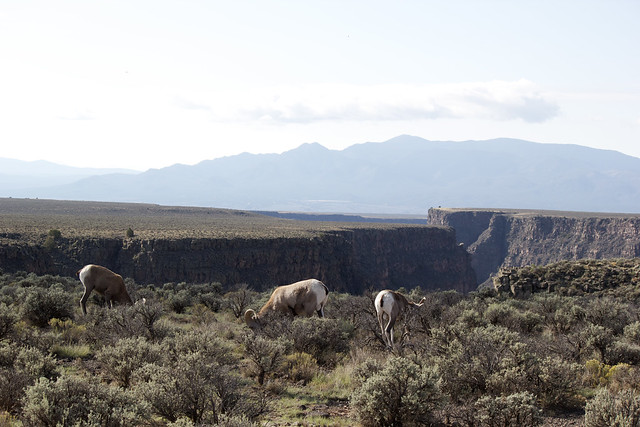
Bighorn

In October, 2012, my luck wasn't so good. I saw only one ewe, from such a great distance that I could barely tell that she was a sheep. Reviewing the photos later, I could see that she was carrying a radio collar.

Why was she wearing a collar? What was the story of interactions between humans and these impressive creatures who, until I saw that collar, I had imagined to be completely wild?

New Mexico Wildlife Center

On July 4, 2015, I was finishing my volunteer shift at the New Mexico Wildlife Center. As I walked out to my car I was met by a weary, late-middle-aged couple. I thought they were going to ask if the Center was open. Instead the lady explained that they had called ahead and were delivering a baby robin, which the man had been hand-raising for the past several days.

This turned out to be one of the most enjoyable afternoons of my recent life. Maybe I'll write it up sometime. For now, the important part is that we passed the next hour or so on the front porch, talking about our respective wildlife encounters.

The man had spent plenty of time watching bighorns in the Taos mountains. And he knew a fair bit about how they had come to be in the Gorge. He explained that they had been introduced only recently, around 2008.

He also told about the old New Mexican sheep herders whom he had befriended when he first moved to Taos, and about the bajadas - the trails – they had used to bring their herds down to the river to drink.

Those bajadas have created a little romantic fantasy in my imagination. The sheepherders are gone, but those trails are still used. I have followed bighorn tracks down some of them. The enduring picture is of a succession of wild sheep, then domestic, then wild again, all finding the same paths down to the water.

Last year I found an article in the Taos News that fleshed out the man's story about how the bighorn came to live along the Rio Grande:

Much like the river otters that now swim in the river at the bottom of the gorge, bighorn sheep were — up until not that long ago — a big part of the order of things in the southern stretch of the Rocky Mountains we call home.

(River otters! That was another wonderful, lucky encounter for me, and the resulting video brought me into contact, through iNaturalist, with one of the people who had helped reintroduce them into the upper Rio Grande. But I digress.)

According to Eric Rominger, bighorn sheep biologist for the New Mexico Department of Game and Fish, bighorns were extirpated in New Mexico around the turn of the 20th century. The last known evidence of a bighorn in New Mexico was a track found in the Truchas Peaks south of Taos.
The reintroduction of the bighorn sheep started in the 1940s when a group of sheep were gathered from Alberta and brought to the Sandias. A herd was started in the Pecos Mountains with a mix of fresh blood from Alberta along with a few Sandia sheep — the founding stock for many of the rest of New Mexico’s herds.
Sheep from the Pecos were brought to the Wheeler Peak Wilderness in 1993. As Michael A. Martinez, hunt coordinator for Taos Pueblo’s wildlife office, said, “Of course, they eventually made their way on the pueblo side. The majority of those bighorns winter on the pueblo side’s abundance of south-facing slopes, moving back to the public side during the summer.”
Then, in 2005, the Taos Pueblo war chief, lead biologist and director of wildlife decided to try to bring the bighorns back to the inverted mountain landscape of the gorge. Taos Pueblo took an initial group of sheep from its side of the Wheeler Peak chain, and the state department supplemented the herd in 2007 with more sheep from the Pecos.

This must be the best combined job title in the world: "Taos Pueblo war chief, lead biologist and director of wildlife."

It bears repeating: I'm deeply grateful for all that Taos Pueblo is doing to care for their home. Bighorn, otters, advocacy for creation of the Rio Grande del Norte National Monument - who knows what else they are doing? The main aim may be to take care of the land, but in doing so they've made it possible for mere mortals to stumble upon amazing animals while out on a day hike.

Beatty's Cabin

This fall I made my first treks into the Pecos north of Cowles. I'd seen photos and video from near the Truchas peaks, of human encounters with proper mountain-dwelling bighorn. I was hoping for similar luck.
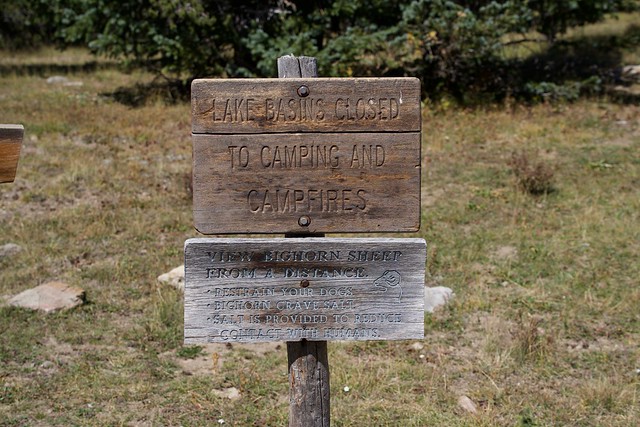
Please don't hound the sheep

Alas, the only bighorn I came across had already had its own, horrible meeting with humans.
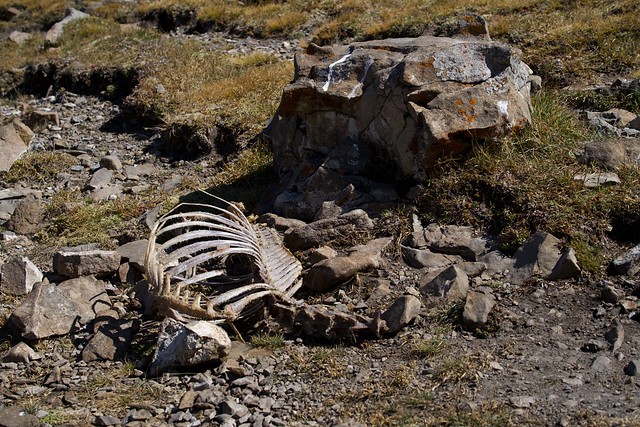
Feast

This year, through a series of lucky accidents, I finally learned about the book "Beatty's Cabin". It's a great, revelatory book. (The web carries several wonderful stories about its author, Elliott Barker, who in his lifetime seems to have regarded the Pecos as his ideal place on earth.)

"Beatty's Cabin" backs up the details of the Taos News article. Like the Nature short film, it explains how bighorn have been harmed both by hunting and by close encounters with domestic sheep.

The Rocky Mountain bighorn sheep, also, were indigenous to this and other areas of the state but their meat was considered the best of all wild meat and, hence, they were sought after like select items on a bargain counter.
In 1873, Coues and Yarrow reported sheep were plentiful in the mountains east of Santa Fe (the upper Pecos) but they were to disappear rapidly after that. Tom Stewart told me many times that the last mountain sheep killed in the area was taken by Jim Bullock at the base of Santa Fe Baldy; near Lake Katherine, in 1902; however, naturalist Vernon Bailey reports in his Mammals of New Mexico that he saw unmistakable tracks of mountain sheep in the Truchas Peaks area in 1903.
It is most probable that rifles were not the sole cause of the depletion of these denizens of the high, timber-line area. When domestic sheep were brought into the high country to graze for brief summer periods, they were often infected with scabies and, perhaps, other communicable diseases or parasites which could easily be transmitted to the bighorns. Domestic sheep could be cured of scabies by forcing them to swim through vats of Black Leaf 40 solution, but Nature provided no such method of treatment for the wild bighorns, and they would be defenseless against the ravages of parasitic infections or diseases new to them, just as the Indians were against smallpox, first brought to them by the white man.

"Beatty's Cabin" ends its story of the bighorn in New Mexico with a statement of hope, one that appears to have been fulfilled.

... with the untimely passing of these spectacular creatures, the jagged crags and templed peaks very definitely lost something of their hereditary charm and glory. On timber-line ridges and in the coves, alpine clover each year sends up its velvety, gray-green leaves and pink-white blossoms in supplication for the return of God’s free wild creatures who once fattened upon its succulence. But none return to eat it. The brows of the high, grassy hills, furrowed and wrinkled by unnatural gullies, frown disapprovingly upon the substitution of herds of domestic woollies for the little bands of wild bighorns that once scanned the glorious landscape from their crests. Restoration is past due.
One effort was made, in 1933, by the State Department of Game and Fish to re-establish bighorns in the Pecos high country. Six animals, two bucks and four ewes, were obtained through the courtesy of the Canadian National Park Service from Banff, Alberta, Canada, and released at the west base of the range. A year later the two rams were seen by Forest Ranger J. W. Johnson at the head of the Pecos on the Santa Barbara Divide, but they have not been heard of since and it must be presumed they met the same fate as their native predecessors. With the material reduction of the number of domestic sheep permitted to summer graze this extremely high vulnerable area and the elimination of the dread scabies from the herds, there is now a good possibility that the Rocky Mountain bighorns might yet be restored to their hereditary range. God speed the day!
Ram

My Heart Belongs to Nature

I'll give the last word to the man who told those great stories on the patio of New Mexico Wildlife Center – and in his own voice, to boot.

2018/12/18

Scripting News sums it up

Scripting News:

That gets boring. It is significant that he's a mob boss. The tragedy is that we can't seem to do anything about it.
Yep.

2018/12/09

Garry Kasparov explains Putin's interest in Syria

Garry Kasparov Says We Are Living in Chaos, But Remains an Incorrigible Optimist | The New Yorker:

There is a war in Syria? Excellent. Obama has washed his hands of it? Great: I go in, displace people, they flee to Europe, this creates problems, the right rises.
A brilliant, in-a-nutshell summary.
... they made a conscious decision to create not a Chinese-type system of blocking access to information but its opposite: a flood of information. They created a deluge. For example, they create entire troll debates. You think that there is an argument raging on the Internet, when in reality it’s a script.
There's much more, well worth reading.

2018/11/28

Burning Fossil Fuels Almost Ended All Life on Earth - The Atlantic

This would be a great read even if it were just science fiction. Beautifully written, start to finish.

Burning Fossil Fuels Almost Ended All Life on Earth - The Atlantic:
Unsurprisingly, there’s no life in these ghastly rocks (even most plant life checks out at temperatures not much more than 40 degrees Celsius), making them exceedingly difficult to date.
“There’s absolutely nothing to date in any of these rocks because everything’s dead,” says Knapp. “But what we can say is that this is definitely Permian.”
...
“I see [a few] possibilities. The first is that things just really got that crazy. Shit happened. The second is that we just really don’t understand positive feedback loops yet. That’s the scary option. The third is that you can’t do it without a supercontinent. We need to be studying these time periods when carbon dioxide caused problems, because right now we don’t understand them at all. It should be a national priority to study the Permian to figure out what the hell happened.”
...
At the top of the canyon the rocks gave up their Martian hue at long last, and were etched with the geological traces of tranquil lakes and river channels and even dinosaur footprints. Up in those rocks the Earth was finally recovering, and the reptiles of the Earth’s most storied age—the Mesozoic—were making their tentative claims to a world that they would come to rule for more than 100 million years. But down here along the dusty trail was the end of the Permian, and the planet was still fighting for its life.
...
Their precious cargo was the lifeblood of civilization. The empty train cars were returning from the nodes of civilization, like spent red blood cells, to this giant, unyielding pump of geological energy in the prairie... They were shuttled along the infrastructural aorta before branching into capillaries where they’d deliver their carbon to far off power plants to be metabolized near cities, by metropolitan mitochondria.

The phrase "global weirding", referring to the strange signs in the fossil record leading up to the Permian extinction, recurs in the article. I can't help thinking that would make a great name for a science-explainer YouTube series...

2018/11/26

Trump Administration’s Strategy on Climate: Try to Bury Its Own Scientific Report - The New York Times

Trump Administration’s Strategy on Climate: Try to Bury Its Own Scientific Report - The New York Times:

In publishing the assessment, White House officials made a calculation that Mr. Trump’s core base of supporters most likely would not care that its findings are so at odds with the president’s statements and policies.
That view is supported by Steven J. Milloy, a member of Mr. Trump’s E.P.A. transition team who runs the website junkscience.com, which is aimed at casting doubt on the established science of human-caused climate change. “We don’t care,” he said. “In our view, this is made-up hysteria anyway.”


From Mann, Michael. The Madhouse Effect: How Climate Change Denial Is Threatening Our Planet, Destroying Our Politics, and Driving Us Crazy (Kindle Locations 1248-1257). Columbia University Press. Kindle Edition:
[Steven J.] Milloy is no scientist, but he’s darned good at playing one on television — Fox News, to be specific — where he is presented as an environmental science expert. Milloy, in this capacity, regularly calls out the “junk science” implicating tobacco products in human health ailments, pesticides in environmental ailments, and fossil fuels in our current planetary ailment.
What Milloy has failed to disclose while busy presenting himself as an independent “junk science” expert on Fox News is that, as noted earlier, he has accepted payments from Phillip Morris, ExxonMobil, and Syngenta for his advocacy efforts. When journalist Paul Thacker reported these facts in the New Republic in 2006, he also reported the reaction from Fox News, which claimed to be unaware of the financial ties and gave Milloy the lightest of slaps on the wrist, conceding only that “any affiliation he had should have been disclosed.”

2018/11/25

Natural gas firms have a proposal to convert home heating to hydrogen | Ars Technica

Good for the U.K.:

Natural gas firms have a proposal to convert home heating to hydrogen | Ars Technica:

The UK has been more aggressive about curbing carbon emissions than the US. In 2015, the country stated that its goal was to close all coal-fired power plants in the country by 2025, and in 2017, the UK electrical grid had its first coal-free day.

I have wished for most of my adult life that the leadership of my country could see economic advantage in pushing toward clean energy, increased energy efficiency, and so on.

If you follow the Fully Charged show on YouTube, by now you've seen lots of ways in which the U.K. is pushing ahead of the U.S. EVs, home batteries and smart grid technology, and more - there's a lot of innovation around energy production and efficiency in western Europe in general.

2018/11/20

On the fundamental interconnectedness of all things

From twitter:

Michael McFaul - @McFaul: Hey @Grady_Booch , I want to learn Python. Whats your recommendation for how at my stage in life?
Grady Booch - @Grady_Booch: Hey @gvanrossum you have another fan.
Professor Michael McFaul is a former U.S. Ambassador to Russia. Grady Booch is perhaps best known for developing UML. Guido van Rossum is the creator of Python, the programming language (and community) that has made my professional life so interesting. Suddenly I wonder whether anything on twitter is real ;)

2018/11/12

Laurence Tribe explains all the ways Whitaker's "appointment" is illegal

Yes, Whitaker's Appointment Is Unconstitutional. Here's How To Challenge It. | HuffPost:

[The Attorney General Succession Act] created a line of succession... which would require the position to be filled in this case by the sitting deputy, Rod Rosenstein. It’s hard to imagine what legislative action could be clearer, unless the Senate is expected to pass the law again, now with the added words “and this time we really mean it.”
[Whether or not Sessions was fired] matters because of the Vacancies Reform Act... For the purposes of the VRA, “vacancies” aren’t created by firing. So if a court were to conclude that Sessions actually “resigned,” then Trump and Whitaker could argue that, because of the VRA, anyone working for the Department of Justice could fill the vacancy for up to seven months (210 days).
Yet even if a court were to agree both that Sessions resigned and that the VRA applies ... any federal court will recognize that the Constitution trumps all. And that’s where the big guns get introduced.
The Constitution in Article II permits Congress to empower “the President alone” to appoint “inferior Officers.” All other “Officers of the United States” ― known as “principal officers” ― must be appointed “by and with the Advice and Consent of the Senate.”
The attorney general, however, is a principal officer entitled to Senate confirmation... But Whitaker was never confirmed by the Senate to his new post, nor to any position in the line of succession to that role, or even to any position with similar responsibilities...
So being time-limited – Whitaker serves, as we’ve noted, for at most 210 days – can’t in itself erase the need for Senate confirmation.

2018/11/10

Empathy

I'm a software developer from the early 1980s - a stereotypical asocial type, not very empathetic, not very well able to understand the world from the perspective of another.

In 2015 an old friend boiled up on social media, aroused by the prospect of Syrian refugees coming to the United States. "Will you fight? I'll fight!" he announced to everyone.

He wasn't alone. Many in the U.S. saw the refugees as terrorists, because of 9/11, Afghanistan, etc., and as cowards, because they were fleeing. "I would stay and defend my home!"

The news at the time carried images of apartment buildings gutted and flattened. What was there to defend? Friends and families lay crushed beneath collapsed concrete or pulped by shrapnel. Who was left to protect?

It was noted even then that climate events had helped trigger the Syrian civil war. A severe drought had killed livestock, raised food prices, made farmers flee from their fields to the cities. The civil war, triggered in part by their government's inability to relieve suffering, had made Syrians of all kinds flee for their lives.

By 2015 I'd traveled a bit. At times I'd lived, very briefly, without heat and running water. That mild experience gave a weak sense of what the world must be like for those refugees. No heat, no water. No food. No shelter from the elements. No place to relieve oneself. No clean clothing - nothing clean.

Try to stop after each of those items. Imagine what your life would be like without that one thing.

I'm lucky: life gave me experiences to compensate a little for my lack of empathy.

This morning the news describes the destruction in California.

Shirley Hertel returned to her Thousand Oaks home Friday morning after watching it catch fire on TV just hours before.
The sight left her in tears.
...
“I don’t even know that I even understand what happened here,” [said Shirley Hertel, a Thousand Oaks resident].
She took the fire — and the water damage she had just fixed in the home last month — as a sign that she should leave the city she’s lived in her whole life, she said. Her other daughters and granddaughter live in Kentucky, she said, and she wants to watch her grow up.
“This will always be my home, but Kentucky is where I’ll live,” she said.

Her home has been destroyed. There is nothing left for her to defend in Thousand Oaks. She is fleeing California for Kentucky.

At least she doesn't need to worry whether Kentucky will let her in.

U.S. citizens are now among the planet's refugees. Will this concrete experience bring us a little empathy?


The Oakies were also climate refugees. But the dust bowl was a long time ago. It can no longer give us empathy through experience.

What can bring us empathy is just as likely, in this case, to bring us a Malthusian mess, with less food, water and livable earth divided among more people.

Read it, and weep

We have become a heartless, stupid people. 'Vaya con Dios:' the impossible life of a judge on the US immigration frontline | US news | The Guardian:

2018/11/07

On Improving Campaign Coverage

Jay Rosen yesterday produced an interesting twitter essay: 'Campaign coverage: the road not taken.' There was a path the American press could have walked, but did not. This alternative way was illuminated as far back as 1992. Our political journalists declined it. And here we are. This thread is that story. One of the problems with election coverage as it stands is that no one has any idea what it means to succeed at it. Predicting the winner? Is that success? Even if journalists could do that —and they can’t — it would not be much of a public service, would it? A very weird thing about horse race or “game” coverage is that it doesn’t answer to any identifiable need of the voter. Should I vote for the candidate with the best strategy for capturing my vote? Do I walk into the voting booth clutching a list of who’s ahead in the polls? In 1992, the @theobserver in Charlotte, NC teamed up with @Poynter to pioneer a different way to cover elections. The idea was very simple: campaign coverage should be grounded in what voters want the candidates to talk about. Which voters? The ones you are trying to inform. This came to be called the "citizens agenda" approach to campaign coverage. It revolves around a single question. Here is the question: "What do you want the candidates to be discussing as they compete for votes?" From good answers to that everything else in the model flows. A few things about that question, "What do you want the candidates to be discussing as they compete for votes?" Notice what it is not. It is not "who's going to win?" It's not "who are you going to vote for?" And it's not "which party would do a better job of addressing..." The whole purpose of the citizens agenda approach is to find an alternative to the horse race style in campaign coverage, which starts with "who's gonna win?" What are the keys to winning? How close is the race? Which tactics seem to be working? What do the latest polls say? The horse race style is the default pattern. It's easy to criticize, and I have done that. A lot. But the default has some impressive strengths. It's repeatable in every election, everywhere. It creates suspense and thus audience interest. It tells you where to put resources. Here’s how the alternative style — the citizens agenda in election coverage— works. First you need to know who your community is. If informing the public is the mission statement of every good journalist, then identifying the public you’re trying to inform is basic to the job. If you can identify the particular public you’re trying to inform — and you know how to reach those people — then you can ask them the question at the core of the citizens agenda. “What do you want the candidates to be discussing as they compete for your vote?” The key is to pose this question (for months) in every possible form. Interviews with reporters. Focus groups with researchers. Call and leave us a message. Email us. Tweet us. Text us. Fill out this form. Speak up at our forum. Comment on our Facebook page. Talk to us! In addition to those inputs, the polling budget has to be redirected. Away from the horse race, toward the organizing principle in our revised approach, “What do you want the candidates to be discussing as they compete for votes?” You can poll for that. But it is not normal. Put it all together, and the journalists covering the campaign have what they need to name, frame and synthesize the citizens agenda. The product is a ranked list, a priority sketch. The top 8-10 issues or problems that voters most want the candidates to be talking about. The citizens agenda, an exercise in high quality public listening, is both a published product (tested, designed, packaged properly for multiple platforms) and a template for covering the rest of the campaign. It tells you how to "win" at campaign coverage. Or stop losing. But you have to get the list right. If you can spread out and properly canvas the community, ask good questions, listen well to the answers, transcend your limited starting points (your bias) and piece together an accurate and nuanced understanding, then you have something. The template has multiple purposes. It helps focus your “issue” coverage and voters guide. It informs your explainers. And it keeps you on track. Instead of just reacting to events (or his tweets...) you have instructions for how to stay centered around voters' concerns. When a candidate comes to town and gives a speech, you map what is said against the citizens agenda. When your reporters interview the candidate, questions are drawn from the citizens agenda. If the candidate speaks to your editorial board, you know what to ask about. But it goes beyond that. Synthesizing a citizens agenda at the beginning creates a mission statement for your election coverage later on. Now you know what you’re supposed to do. Press the candidates to talk about what your readers and listeners want most to hear about. The citizens agenda approach in campaign coverage (sorry for the dorky name) also tells reporters, editors and producers how they’re doing. Because if you’ve done the work and your list is accurate, the candidates will have to start talking about the items on that agenda. That’s how you know it’s working. That’s how you know you’re winning. Now you can press for better answers, and dig deep on things you know people care about. Public service! This I can tell you. If reporters ask the people they’re trying to inform, “What do you want the candidates to be discussing as they compete for votes?” no one is going to reply with, “You’re down five points in the latest polls. Realistically, can you recover?” The citizens agenda approach in campaign coverage was first tried at the @theobserver in Charlotte, NC in 1992. I wrote about that adventure in my book, What Are Journalists For? in 1999. I explained it again in 2010 at my blog. http://pressthink.org/2010/08/the-citizens-agenda-in-campaign-coverage/ So it's been out there. My own read is that it never took off because this is not what political reporters want to do. They want to hang with the pros. They want to pick apart the strategy. The best ones (and there are some very good ones) want to explain what the candidates are appealing to. In us. Yesterday, @Sulliview gave a grade of C-minus to the campaign press. “Too many journalists allow Trump to lead them around by the nose,” she said. “With the president as their de facto assignment editor.” https://www.washingtonpost.com/lifestyle/style/defensive-caravan-fixated-and-trump-obsessed-the-media-blow-it-again-just-not-as-badly/2018/11/04/e4c9efcc-deb7-11e8-b3f0-62607289efee_story.html And I agree with that. But here's the kicker... You can’t keep from getting sucked into Trump’s agenda without a firm grasp on your own. But where does that agenda come from? It can’t come from you, as a campaign journalist. Who cares what you think? It has to come from the voters you are trying to inform. A demonstrable public service, the citizens agenda approach puts the campaign press on the side of the voters and their right to have their major concerns addressed by the people who are bidding for power. This is the road not taken. Now I have to add that good reporters on the campaign trail spend a lot of time listening to voters. This happens. They ask about the issues on voters' minds. But it’s pitched to who’s ahead and why. To which appeals are resonating. To the sophisticated professionals who cover elections, the “citizens agenda in campaign coverage” sounds — let’s be honest — a little too earnest, a bit minor league. Civics class, as against drinks with political insiders at the Des Moines Marriott. I know this. I get it. Thing is, the only way up from the hole they’re in is to pitch their journalism at an electorate they understand better than the politicians who are leading it off a cliff. You don’t get there with a savvy analysis of who’s going to win this round. You have to represent. 6 November

2018/11/01

The Trump Administration's Fuel Efficiency Math Is All Wrong - The Atlantic

This is what you get by deleting unpleasant facts. The Trump Administration's Fuel Efficiency Math Is All Wrong - The Atlantic:

The fine print of the proposal says that “newer, safer cars” will prevent 30 deaths every year at most—a far cry from the claimed 1,000. But an EPA memo included in the proposal warns that safe will increase traffic fatalities, leading to 17 more deaths every year.
In any case, “a large portion” of the lives that safe claims to save ... arise instead from an erroneous calculation spat out by a broken computer model; and an assumption—never advertised by the Trump administration—that Americans will drive less when forced to buy less fuel-efficient cars.
At a crucial moment in the scrappage model’s analysis, it mysteriously deletes roughly 700 billion miles of nationwide driving from its simulation of the Trump rollback. It does so due to a nonsensical assumption that owners of old cars—cars built between 1977 and today—will drive much, much less under the rollback than they would under the Obama-era rules.
Read the whole article. The Trump administration seems intent on using lies and distortions to justify its prejudices.