Showing posts with label energy. Show all posts

2019/11/03

Charged EVs | New study: 10 percent EV penetration could shift utility’s entire peak load

Driving a PHEV has taught me that, for daily commutes, "lack of charging infrastructure" isn't really a thing. The charging infrastructure already exists. It's the electric service to your garage or carport. Come home, plug in, and wake up to a full "tank".

Plug-in vehicles that arrive home with some charge remaining can even solve a problem for the grid as a whole, by reducing peak demand. Just add vehicle-to-grid.

Charged EVs| ... 10% EV penetration could shift utility’s entire peak load:

“We were surprised both at the relatively small 10 percent EV market saturation required to completely clip the SCE residential peak and the large annual savings…even after paying for nighttime recharging,” Jackson Associates President Jerry Jackson told Utility Dive.

2019/10/19

BEV, ICE and Cobalt: an illuminating Twitter thread

Thanks to Robert Llewellyn for resuscitating the following Twitter thread. Unfortunately, the thread is so old that neither Thread Reader App nor Twitterrific is able to retrieve it. Twitter's web interface can still retrieve it, so I've taken the liberty of transcribing it below.

Synchronicity on Twitter: "The Dirty Secrets of #ICE - Part 1..." / Twitter:

The Dirty Secrets of #ICE - Part 1 Whenever there’s a debate about the benefits of battery electric vehicles #BEV vs internal combustion engine #ICE vehicles, one of the 1st things usually mentioned is cobalt with lurid stories such as linked here.
But when you fill your tank with petrol or diesel did you know that cobalt is used as a key ingredient?
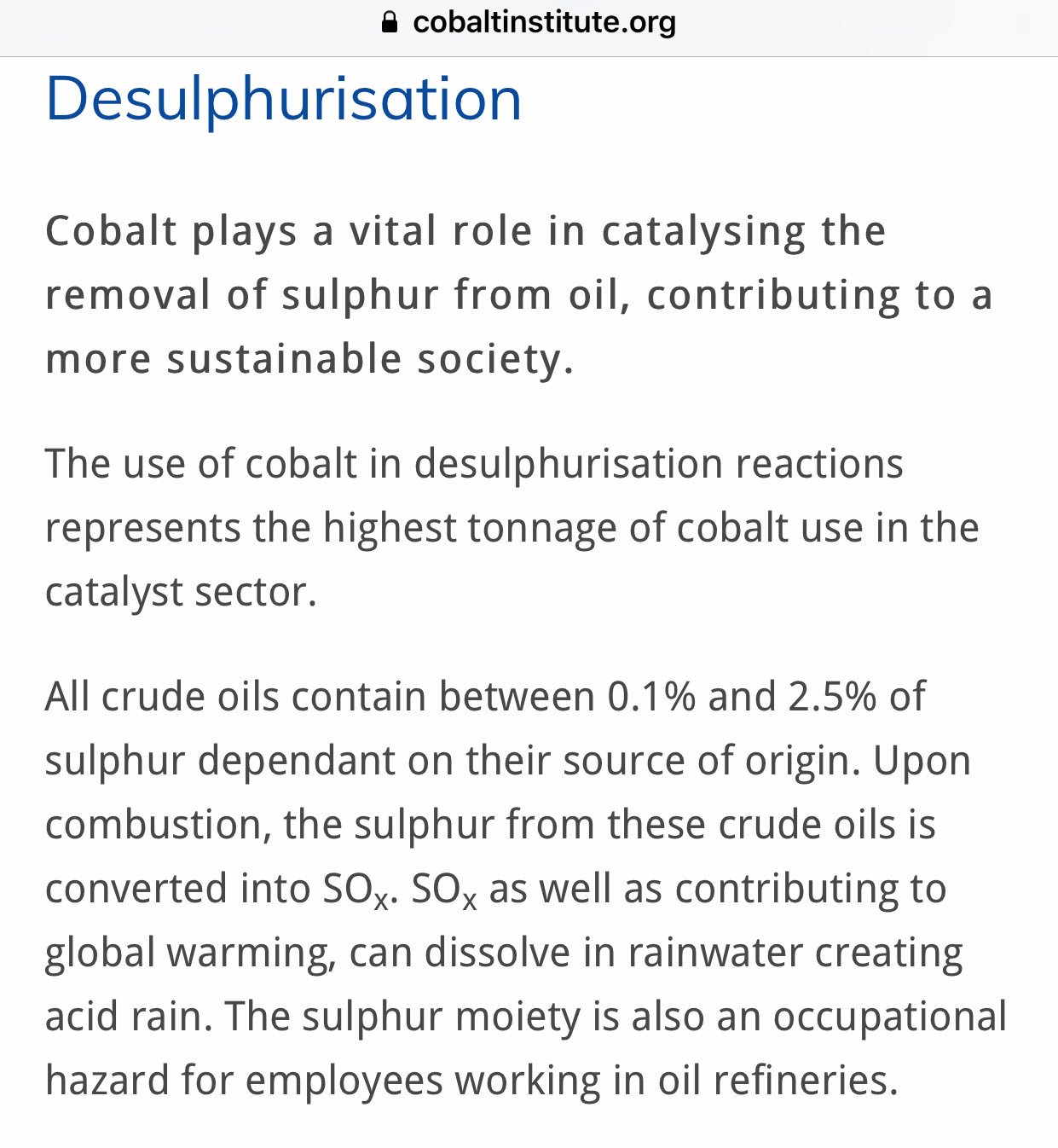
When we figured out that sulphur in our fossil fuels was a key component to acid rain (remember acid rain?) & also contributed to serious health issues it was decided that ultra low sulphur fuels was the way to go. But the catch is that removing sulphur during the refining process is actually quite hard. You need something to act as a catalyst to aid the Desulphurisation process. So they added a metal to kick start the key reaction.
And yes, the metal they add is cobalt. Here’s the lowdown from the “Cobalt Institute” (cont) https://cobaltinstitute.org/desulphurisation.html
It’s a long and detailed article but the key information is in the first few paragraphs.
So to make low sulphur petrol & diesel, which is the global standard now, they must add cobalt during the refining process. Yes, but that cobalt doesn’t get into the final product we put into our tanks right? Right?? Wrong!!! In fact a lot is left in the final output.
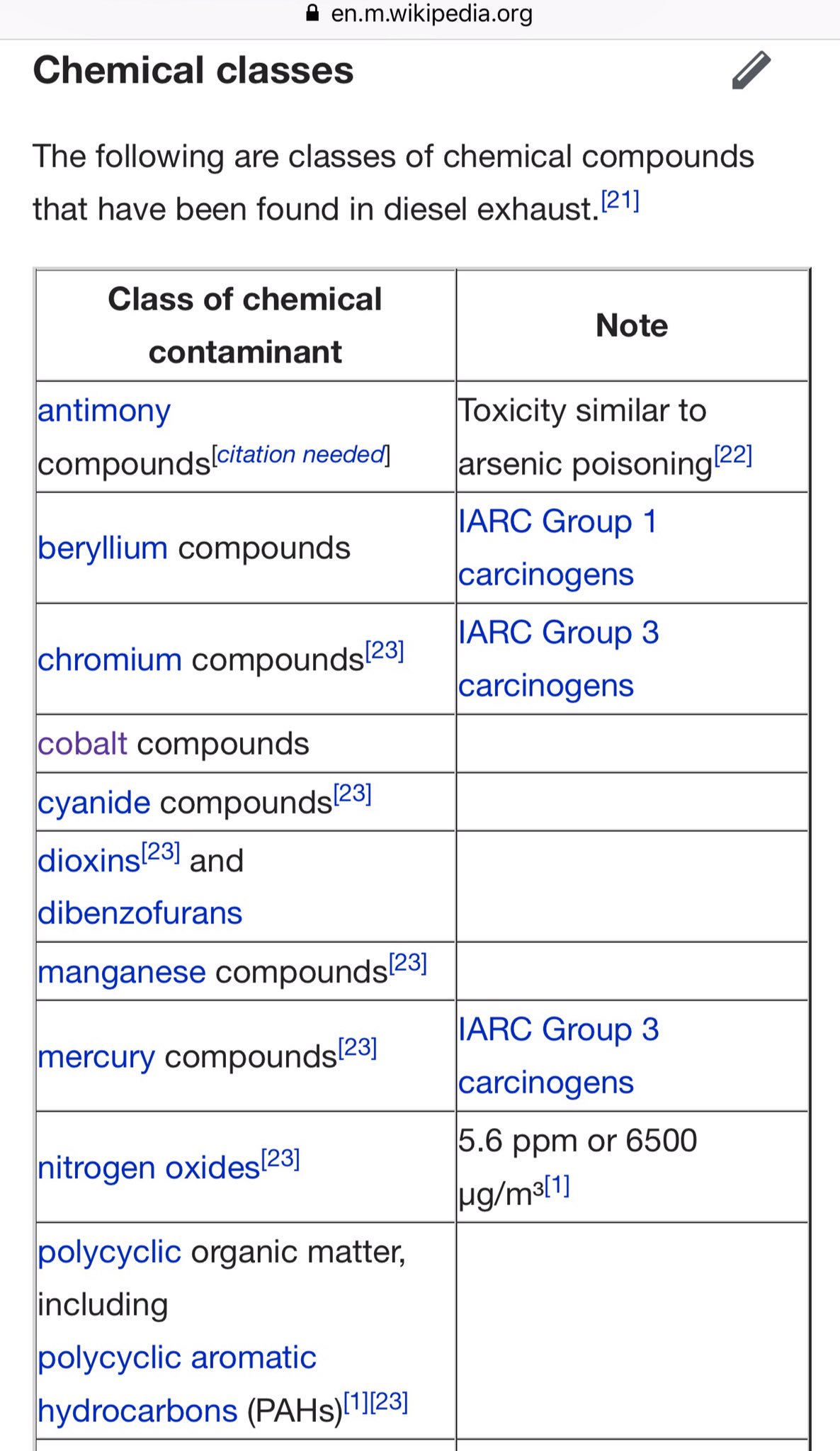
Check out the list of toxins and carcinogens that make up ordinary everyday diesel exhaust emissions for instance. Yes it’s a long list of nasties but look who’s there? Yes, it’s our friend cobalt.
So when the anti-BEV lobby start shouting about cobalt in batteries, tell them about the cobalt in their fuel. At least the cobalt in the battery *stays* in the battery and can be completely recycled. The cobalt in their fuel is spewed out the exhaust for our children to breathe.
And then we should consider how Cobalt relates to EV batteries. So this from Amnesty International confirms that about 20%, at most, of the cobalt from the DRC is hand mined. The rest is machine mined.
Overall, about 60% of the world’s supply comes from the DRC. So that means only about 12%, at the very most, of the global supply of cobalt is actually hand mined. Also add that a lot of that cobalt is used for other things like high quality steel, and the fact that a lot is also used in cell phone, tablet, laptop batteries, and petrol/diesel fuel of course, and that the amount of cobalt actually in EV batteries has fallen dramatically. The chances of hand mined cobalt getting into your EV battery is next to nil.
So it’s just disingenuous & misleading to link unethically sourced cobalt solely with EVs when in reality it’s used for a lot more other applications in every part of our society. But of course it serves many parties with anti-EV interests for that false association to be made.
Some selected replies:

simon blackmore @blackmore_s Jun 20

#FFS the #FUD they peddled about BEV's battery chemistry and they are pumping that crap into the air via exhaust fumes.

DIYMicha @DIYMicha Jun 22

... and cobalt is an ingredient in hardened high temperature steel, used in valves and valve seats of ICE engines.

Synchronicity @Synchronicity34 Jun 22

Yes indeed, mentioned further down in the thread.

Synchronicity @Synchronicity34 Jun 21

But the cobalt in batteries stays in the batteries and is then recycled. The cobalt in fuel is distributed though our most populous cities, day upon day, accumulating on our streets, in the air, in our children’s lungs. Which source should you be most immediately worried about?

Synchronicity @Synchronicity34 Jun 21

Key research on the long term cumulative effects of our children ingesting heavy metal particulates such as cobalt are only just starting. I don’t think you are qualified to say whether any other issue is bigger.

A World We Built to Burn - Quinn Norton

A World We Built to Burn | emptywheel:

So here we are: Keeping the lines on will probably kill people. Turning them off will probably kill people. Our political system is facing a real-life trolley problem created by our ever-expanding technical debt. It can’t have been easy for the people making the decisions.
One of our jobs in this century is to accept that we don’t live on the planet we thought we lived on, and our societies aren’t doing what we thought they were. Even if we were able to change our politics overnight, which is probably impossible without some planetary level disaster wake up call, it would still take many decades to dig ourselves out of out technical debt, and in the mean time, we have to stay alive and try to thrive.
I can imagine you looking at the screen, saying “It shouldn’t be this way!” But it is this way. The world we thought we had, with a safe stable environment and not too many people, that is not the world we live in. That is, in short, not real. At the individual level as well as the policy level, we need to let go of that which is not real.
Framing a mesh of interrelated social, political and environmental problems as technical debt is brilliant. Finding it on emptywheel, a site that I visit for its insights into the takeover of our federal government, is surprising but welcome.

2019/04/18

New Mexico seeks energy savings in state building upgrades | Local News | santafenewmexican.com

New Mexico seeks energy savings in state building upgrades | Local News | santafenewmexican.com:

New Mexico is pushing forward with multimillion-dollar, energy-saving upgrades to its portfolio of agency buildings in the state capital, as part of an emerging climate-change strategy from Democratic Gov. Michelle Lujan Grisham.
The General Services Department which oversees more than 800 buildings plans to invest $32 million on projects to improve the energy efficiency of state buildings in Santa Fe and generate on-site renewable electricity with photovoltaic solar panels.
The state government’s first battery storage for solar energy is part of the project.
State legislation approved this year provides $20 million in direct spending on the energy upgrades at state buildings.
The contractor hired to implement building improvements in Santa Fe has guaranteed energy-related savings of $1.1 million a year... The state expects actual annual savings of about $1.4 million.
Separately, General Services said it has received $1 million in state funds to purchase electric vehicles for use by state workers. Another $1.5 million is going toward the creation of vehicle charging stations at state facilities within Santa Fe County.
It's very encouraging to see all of this. Thank you, Governor Lujan Grisham.

2019/04/02

North Carolina Orders Duke Energy to Excavate All Coal Ash - The New York Times

Michael Shellenberger has observed that, of all current types of electricity generation, only nuclear has the cost of waste management included in its price. Now some of that cost is being rolled, almost retroactively, into the cost of electricity from coal. North Carolina Orders Duke Energy to Excavate All Coal Ash - The New York Times.

2019/04/01

Is Nuclear Power the Key to Finally Reducing the CO2 Footprint?

NB: These are essentially the same points Michael Shellenberger makes, but they come from a different source. Is Nuclear Power the Key to Finally Reducing the CO2 Footprint?:

In about 20 years, at a cost of at least two hundred billion dollars, it has added about 80 gigawatts of wind and solar generating capacity—enough in principle to cover its winter peak—to its energy mix, an amazing feat in itself.
the International Energy Agency shows that the amount of CO2 generated per kWh of electricity in Germany is still about 480 grams, despite their large investment in wind and solar technology. The reason is that the country still relies on coal and natural gas for about half of its electricity, as its wind and solar fleet lay idle most of the time. In the meantime, France—which relies on nuclear power for 75 percent of its electricity—generated only about 70 grams of CO2 per kWh. When France decided to go nuclear after the first oil shock in 1973, it derived about two thirds of its power from coal and oil-fired power plants and emitted 500 grams of CO2 per kWh. Twenty five years later, its power sector was almost carbon-free.
Because of its reliance on nuclear power, France currently has one of the lowest rates of CO2 emissions per kWh in Europe. Every year, the French power sector emits approximately 260 million fewer tonne (metric ton) of CO2 than its German counterpart, despite similar productions (respectively 560 billion kWh and 630 billion kWh). This is equivalent to taking 175 million cars off the road (assuming an average emission of 0.15 kg-CO2 per car and per km and 10,000 km per car and per year)—about 75 percent of the whole European fleet of personal vehicles.
Delays in implementation caused by legal and regulatory issues—in particular those associated with long-term liability—are likely when it comes to choosing the sites that will have to permanently host billions of tonnes of CO2. Such delays have been happening for the geological disposal of used nuclear fuel. However, unlike used nuclear fuel, which can be safely stored at reactor sites while waiting for a final disposal solution, CO2 is currently released to the atmosphere until a final solution emerges—which could take a while.
After more than two decades spent analyzing available data, experts from institutions such as the World Health Organization and the United Nations Environment Program, concluded that 43 people died of causes directly attributable to the Chernobyl accident. They also indicate a potential 3 percent increase in cancer mortality in the 600,000 most exposed people. In such a large population, unfortunately, more than 120,000 lethal cancers are expected to occur spontaneously—independently of any radiation exposure—and the Chernobyl accident may add 4,000 cases to this macabre toll. However, a long standing issue associated with this predicted increase is that it cannot be verified with certainty because it is much smaller than—and mostly undistinguishable from—the background of spontaneous cancers.
Finally, whereas most of the general public will very likely point at the Chernobyl and Fukushima accidents as the worst modern science and engineering failures, only very few will remember the 1975 collapse of the Banqiao dam (China) where approximately 26,000 people died from flooding and another 145,000 died because of epidemics and famine. Another dam, Machchu-2, in India also failed a few years later (1979) killing at least 2,000 people. Experience shows that nuclear power does not entail more risk than other industries.
Assuming a typical consumption of 7,000 kWh per year, a person living in San Francisco would be responsible for the production of about 6.2 cubic centimeters of used nuclear fuel per year weighing 18 grams if the electricity came only from a nuclear power plant. It would take about 55 years for this person to fill the equivalent of a can of soda with used nuclear fuel. So, yes, these used fuel assemblies contain very dangerous materials—standing next to one, unprotected, would kill you in a few minutes—but there is very little of it. If the same electricity had come only from a gas—natural or bio—power plant during the same 55 years, that person would have been responsible for the emission of about 190 tonnes of CO2—900,000 cans of soda or one every half-hour—and twice that amount if it had come from a coal power plant.

In New Mexico, renewables don't always mean clean energy | Local News | santafenewmexican.com

2008 brought plans to erect wind turbines across the Taos plateau. Last year long-distance transmission lines were ready to carry wind power across the bird migration routes near the Bosque del Apache. And now this: a geothermal plant may be harming an aquifer in New Mexico's Animas Valley. This is an interesting read from the Santa Fe New Mexican, about roses, tilapia, politics and energy politics: In New Mexico, renewables don't always mean clean energy | Local News | santafenewmexican.com:

Riding his horse through cattle pasture of brush and brittle mesquite, Randy Walter spotted a 10-foot geyser spewing from a well that had been capped and padlocked for 12 years.
The dark side of renewable energy is that every form of production carries its own environmental baggage.
During the 2012 legislative session, Southern New Mexico Democrats Sen. John Arthur Smith and Rep. Rudy Martinez co-sponsored a bill that took jurisdiction over 250-plus-degree water from the Office of the State Engineer and placed it in the hands of the Oil Conservation Division.
In other words, the hot water was no longer considered water, but energy. The agency historically tasked with managing water in New Mexico was stripped of its authority over the project.
One of the people unafraid to speak out is Meira Gault, a 69-year-old cattle rancher who once served in intelligence in the Israeli Army and has been a Hidalgo conservation district official for 11 years.
Gault said she views the well blowout as the surest sign that the geothermal water simply isn’t going where Cyrq promised it would go.

2019/03/29

Lightning Strike Prototype Review - Cycle News

I've complained since the invasion of Kuwait that the U.S. was missing an opportunity to develop energy-efficiency technology - that the rest of the world would pay to buy. Of course I missed the idea of developing "alternative" (non-fossil-fuel) energy tech, etc. Anyway, this is encouraging news: some U.S. businesses are intent on doing exactly that. Witness Lightning Motorcycle Group: Lightning Strike Prototype Review - Cycle News:

...we think India will be right there with [China, as a market], basically to address the environmental problems that they face at present...
the two largest motorcycle markets in the world will both predominantly focus on electric motorcycles in the coming years, and Lightning will be there to serve them.

2019/01/11

2019/01/06

The Green New Deal, explained - Vox

<humor>This wide-ranging article leaves the impression that the Green New Deal is, like the article itself, doomed by its broad scope.</humor> I will randomly quote one of its many interesting points.

The Green New Deal, explained - Vox:
... climate change impacts are going to cost more than climate mitigation anyway. The GND is big, but “big things will happen,” says Chakrabarti. “The two options are, either we’re going to intentionally do the big things we want, or big things we don’t want will happen to us.”

We're screwed if we do nothing. Might as well find some interesting weak spots and start working on them.

Play Bill

I sometimes have trouble keeping track of people quoted in articles. Here's a playbill for this one.

People

Evan Weber: a co-founder of the Sunrise Movement.

Rhiana Gunn-Wright: a policy analyst employed by the nascent New Consensus.

Saikat Chakrabarti: Chief of Staff to U.S. Rep. Alexandria Ocasio-Cortez, and a co-founder of Brand New Congress.

Greg Carlock: a researcher, essayist and podcaster who writes about U.S. policy, governance, climate change, the Green New Deal, and political philosophy. Currently works for Data for Progress. If he were a software developer, I think he would be an advocate for rapid prototyping; the article quotes him as favoring the method (for new policy/programs) of "Pilot and scale".

Organizations

Sunrise Movement: a youth-led organization advocating for a Green New Deal (bold climate action coupled with efforts to address worsening social inequities).

Data for Progress: bills itself as "the think tank for the future of progressivism", and as representating citizens who believe in Medicare for all, a Green Job guarantee, and the abolition of ICE.

New Consensus: a policy non-profit that identifies itself as follows:

We are a global, distributed network of academics, creators, activists, leaders and entrepreneurs working to make the new consensus the standard operating system for national economies around the world.

Brand New Congress: an organization founded after the 2016 elections with the goal of recruiting 400 "fresh new faces" to run for Congress.

2018/12/22

Lamar Smith Got His

LAMAR SMITH: A ranch, an oil field, and a career colored by skepticism -- Friday, December 21, 2018 -- www.eenews.net:

As fossil fuels were being removed from his Texas lands, Smith was making a name for himself as a sharp skeptic of climate science...
"It's important for the American public, for constituents, to know what their members are invested in, where their financial ties are, to make sure that they're acting in good faith," said Alex Baumgart, a researcher with the nonpartisan Center for Responsive Politics. "To make sure that the policies being implemented are not self-serving and that they are geared toward constituents instead of furthering a financial interest."
Also see Wikipedia.

2018/11/28

Burning Fossil Fuels Almost Ended All Life on Earth - The Atlantic

This would be a great read even if it were just science fiction. Beautifully written, start to finish.

Burning Fossil Fuels Almost Ended All Life on Earth - The Atlantic:
Unsurprisingly, there’s no life in these ghastly rocks (even most plant life checks out at temperatures not much more than 40 degrees Celsius), making them exceedingly difficult to date.
“There’s absolutely nothing to date in any of these rocks because everything’s dead,” says Knapp. “But what we can say is that this is definitely Permian.”
...
“I see [a few] possibilities. The first is that things just really got that crazy. Shit happened. The second is that we just really don’t understand positive feedback loops yet. That’s the scary option. The third is that you can’t do it without a supercontinent. We need to be studying these time periods when carbon dioxide caused problems, because right now we don’t understand them at all. It should be a national priority to study the Permian to figure out what the hell happened.”
...
At the top of the canyon the rocks gave up their Martian hue at long last, and were etched with the geological traces of tranquil lakes and river channels and even dinosaur footprints. Up in those rocks the Earth was finally recovering, and the reptiles of the Earth’s most storied age—the Mesozoic—were making their tentative claims to a world that they would come to rule for more than 100 million years. But down here along the dusty trail was the end of the Permian, and the planet was still fighting for its life.
...
Their precious cargo was the lifeblood of civilization. The empty train cars were returning from the nodes of civilization, like spent red blood cells, to this giant, unyielding pump of geological energy in the prairie... They were shuttled along the infrastructural aorta before branching into capillaries where they’d deliver their carbon to far off power plants to be metabolized near cities, by metropolitan mitochondria.

The phrase "global weirding", referring to the strange signs in the fossil record leading up to the Permian extinction, recurs in the article. I can't help thinking that would make a great name for a science-explainer YouTube series...

2018/11/25

Natural gas firms have a proposal to convert home heating to hydrogen | Ars Technica

Good for the U.K.:

Natural gas firms have a proposal to convert home heating to hydrogen | Ars Technica:

The UK has been more aggressive about curbing carbon emissions than the US. In 2015, the country stated that its goal was to close all coal-fired power plants in the country by 2025, and in 2017, the UK electrical grid had its first coal-free day.

I have wished for most of my adult life that the leadership of my country could see economic advantage in pushing toward clean energy, increased energy efficiency, and so on.

If you follow the Fully Charged show on YouTube, by now you've seen lots of ways in which the U.K. is pushing ahead of the U.S. EVs, home batteries and smart grid technology, and more - there's a lot of innovation around energy production and efficiency in western Europe in general.

2018/04/18

"Be a Good Ancestor"

China made solar panels cheap. Now it’s doing the same for electric buses. - Vox:

The rapidly growing megacity of Shenzhen, China, was choked with diesel pollution in the early 2010s. Though buses were just 0.5 percent of the city’s vehicles, they were responsible for 20 percent of the air pollution. So, as the World Resources Institute recounts, Shenzhen electrified them. All 16,359 of them.
It got there through some cleverness — they planned out charging infrastructure and pushed manufacturers to offer lifetime warranties on batteries — but mainly through government subsidies, which covered up to half the upfront cost of the vehicles.
In 2013, China was bopping along with 1,700 BEBs. ...it realized that its rapidly expanding urbanization could not continue to rely on diesel buses, lest it make an already crippling air-pollution problem even worse.
So it decided to make electric buses a thing. How? By dumping a giant pile of money on the problem, subsidizing the purchase of more than 350,000 BEBs in the following four years.
Other cities are beginning to get on the BEB bandwagon as well.
[BNEF writes that] “Paris aims to electrify all of its 4,500 buses by 2025, Copenhagen has committed to procure only zero-emission buses from 2019, and Los Angeles has the same target for its fleet of 2,200 buses by 2030.”
sometimes problems are big and urgent, you need scaled-up solutions quickly, and you just don’t have time to mess around. China didn’t nudge its solar industry, it kicked it in the pants. Now it’s doing the same to the BEB industry.
As economists will rush to point out, there have been enormous inefficiencies and waste along the way, money lost on graft or junk technology. Solar has often been poorly installed or curtailed. According to BNEF, some 43 percent of the BEBs allegedly produced in China in 2015 were basically fraudulent.
[China] rightly recognized that the problems (coal and diesel pollution) are intensely urgent and it’s not that huge a mystery how to solve them.
Amortized over the next 50 to 100 years, the next several generations of humanity, the cost of transition are a screaming deal at almost any price. It’s just a matter of learning (or perhaps relearning) to take a long-term view of human interests — to be a “good ancestor,” as they say.

2017/12/07

U.S. Sen. Martin Heinrich: Why hinder a rapidly growing industry?

Why hinder a rapidly growing industry? | Albuquerque Journal:

Only a little more than 1 percent of the hundreds of thousands of American solar workers manufacture solar panels or modules. Even within solar manufacturing as a whole, approximately 20 times more American workers work for companies like New Mexico’s Unirac that manufacture other equipment used to produce solar power. Those companies have warned that they may have to lay off employees if the United States imposes costly tariffs or quotas on imported panels.

2017/09/25

Nuclear Experts Head to China to Test Experimental Reactors - Bloomberg

Nuclear Experts Head to China to Test Experimental Reactors - Bloomberg:

“China by a very large margin is the largest market in the world for new power plants of any type,” said Charles W. Forsberg, a professor at MIT. “If we do not get our act together, the low-carbon energy business will be owned by the Chinese.”
Yup.

2017/05/12

Opportunity Lost?

Since Saddam Hussein invaded Kuwait in 1990 I've been wondering why the U.S. has ignored opportunities to develop technologies - for improved energy efficiency and alternative energy – that would have such an obviously large market around the world. Talk about lost opportunities: Three Reasons to Believe in China's Renewable Energy Boom:

"It’s not just pollution that’s driving the determined focus on renewable power. Leaders have made clear that they view clean energy as a powerful engine for job creation."
"“It’s about setting up for manufacturing dominance,” Liu says. “China sees green energy as an opportunity where it can become a manufacturing monster the way it has in clothes and toys.”"
Edit: forgot to add the counterpoint. Rick Perry is a bright spot in a very dismal, autocratic administration. (The following are mostly quotes of quotes.)
"Although EPA Chief Scott Pruitt seems more than happy to blow up his own agency, Perry has gone in the opposite direction. The Energy Department has been cheerleading non-stop for renewables and clean tech with a flood of press releases, and Perry has backed that up with missives from his own @SecretaryPerry Twitter account."
"More than 133,000 energy efficiency jobs were added in 2016, bringing the total number of Americans working in the sector to 2.2 million people. More than half of those jobs (1.4 million) are in the construction industry alone."
"More than a quarter of the energy efficiency workforce (552,000 workers) is related to efficient appliances, including high efficiency heating and cooling equipment. That’s a 58% increase from 2015."
"DOE-backed research in solid-state lighting has yielded more than 260 patents and a significant industry footprint, with literally millions of products currently on the market based, at least in part, on these technical advancements. These products are estimated to have contributed to more than $2.8 billion in savings for consumers and businesses – an impressive return on an investment of about $350 million."

2017/03/27

Fuel Economy Standards vs. Vehicle Costs

From The ‘Job-Killing’ Fiction Behind Trump’s Retreat on Fuel Economy Standards:

"...the original CAFE standards were signed by President Gerald Ford, a Michigan Republican, in 1975. The key Clean Air Act provisions that successfully slashed tailpipe pollution, and that provide the legal basis for the more recent motor vehicle greenhouse gas standards, were developed under the administration of Richard Nixon, who signed them into law in 1970... Both Nixon and Ford were business-friendly Republicans, but ones who recognized that as national leaders they had many other legitimate public concerns to address."
"Trimming a vehicle’s CO2 emission rate may involve, for example, developing a new transmission... Those development costs mean jobs for engineers. Building the redesigned transmissions then creates jobs for assembly workers. So whatever additional costs are incurred go right back into materials and labor, including jobs for steelworkers and others involved in supplying parts and materials to the auto industry."
"The latest market collapse, in 2008, triggered massive job losses — even though it followed two decades of declining vehicle efficiency tied to stagnant CAFE standards."
In the years before the recession GM was warning that their obligation to pay employee health care costs – not fuel economy standards – would bankrupt them. In 2005, retiree health care costs added about $1,300 to the cost of every GM vehicle.
"Automakers note that according to EPA’s own economic analysis, they will have to cumulatively spend $200 billion to comply with the standards over the 2012-2025 period... Over that same time period, the new car and light truck market will rack up at least $7 trillion in revenue. So the $200 billion cost estimate amounts to only 3 percent of gross sales."
Recap: in 2005, retiree health costs added $1300 to each vehicle. In a new vehicle costing $30,000, about $875 will be attributable to fuel economy standards.
Update: I arrived at that figure by simple math, but it turns out the EPA's estimate is similar. From gm-vol.com:
"The Environmental Protection Agency had estimated that automakers would have to spend an additional $875 per vehicle to meet the second phase standards starting in 2022, compared to 2021 standards. The [study by the research group International Council on Clean Transportation] reported that cost would only go up by about an additional $551 per vehicle."

"...the move to begin raising CAFE standards actually began under the George W. Bush Administration, which crafted the 2007 energy bill calling for much higher standards."
"And if the autoworkers bussed in by GM, Ford, and Chrysler to cheer for Trump at his Michigan rally think that gutting regulations is going to create jobs, well, they will have been fooled again."
That seems like a big "if" – I wonder if anyone has actually asked them what they think.

2017/02/04

President Of Audi Of America Tells Dealers To Embrace Plug-In Electric Vehicles | CleanTechnica

President Of Audi Of America Tells Dealers To Embrace Plug-In Electric Vehicles | CleanTechnica:

""And [Keogh] advised them to start thinking now about opportunities to earn money around battery-electric vehicles to offset the lower service and parts revenue they will provide.""
"Interestingly, Keogh also mentioned that he thought widespread price discounting was setting up dealers for future problems. The loss accompanying price discounting is typically being recovered by service and parts revenue, something that won’t persist into a future with strong plug-in sales."

2017/02/02

US Clean Energy Jobs Surpass Fossil Fuel Jobs | CleanTechnica

This CleanTechnica post uses a broad definition to sweep jobs into the "clean energy" category. I wish it had considered jobs related to energy efficiency separately. Even so, it appears from the summary that:

  • electricity production from clean energy sources employs more people (350,000) than does production from fossil fuel sources (200,000)
  • the number of jobs in the clean electric industry is growing, whereas fossil fuel jobs are declining slightly
US Clean Energy Jobs Surpass Fossil Fuel Jobs By 5 To 1 | CleanTechnica
"More than 350,000 people last year worked in part or in whole on solar energy production ... exceeds the combined employment of coal, gas, and oil workers connected with producing electricity that reached just under 200,000. "
"All told, nearly 1 million Americans are working near- or full-time in the energy efficiency, solar, wind, and alternative vehicles sectors. This is almost five times the current employment in the fossil fuel electric industry, which includes coal, gas, and oil workers. "