Showing posts with label ecology. Show all posts

2019/02/13

Plummeting insect numbers 'threaten collapse of nature' | Environment | The Guardian

Plummeting insect numbers 'threaten collapse of nature' | Environment | The Guardian:

“The main cause of the decline is agricultural intensification,” Sánchez-Bayo said. “That means the elimination of all trees and shrubs that normally surround the fields, so there are plain, bare fields that are treated with synthetic fertilisers and pesticides.” He said the demise of insects appears to have started at the dawn of the 20th century, accelerated during the 1950s and 1960s and reached “alarming proportions” over the last two decades.
He thinks new classes of insecticides introduced in the last 20 years, including neonicotinoids and fipronil, have been particularly damaging as they are used routinely and persist in the environment: “They sterilise the soil, killing all the grubs.” This has effects even in nature reserves nearby; the 75% insect losses recorded in Germany were in protected areas.
... organic farms had more insects and that occasional pesticide use in the past did not cause the level of decline seen in recent decades. “Industrial-scale, intensive agriculture is the one that is killing the ecosystems,” he said.
“When you consider 80% of biomass of insects has disappeared in 25-30 years, it is a big concern.”

2018/12/19

Notes on the Fickle Fortunes of Bighorns

"Running With The Herd: A NATURE Short Film" meshes with some recent reading. Rough notes follow.

Flickr

In 2010, on Flickr, I saw photographs of bighorn in the Rio Grande Gorge, taken by a river guide. This created a tiny ambition to see them for myself.

On July 4th, 2011, I took a walk along the West Rim Trail, not really expecting to see anything - after all, this trail is more than 700 feet above the box. But I was lucky, and I got to spend a half hour or so watching three ewes and a lamb feed near the edge of the rim.

A couple of months later I returned and, in nearly the same spot, was stopped in my tracks by three young rams, who grazed right up to where I was standing.
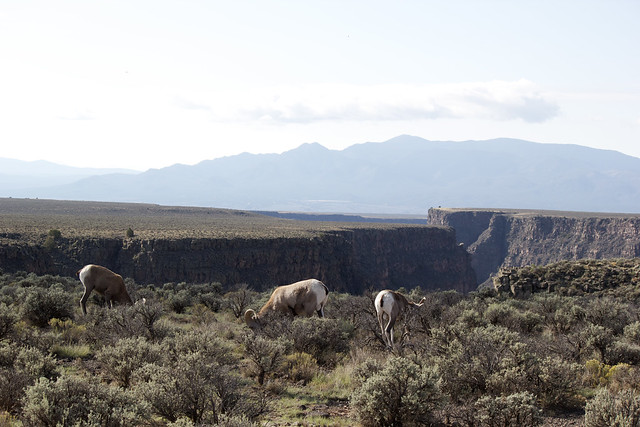
Bighorn

In October, 2012, my luck wasn't so good. I saw only one ewe, from such a great distance that I could barely tell that she was a sheep. Reviewing the photos later, I could see that she was carrying a radio collar.

Why was she wearing a collar? What was the story of interactions between humans and these impressive creatures who, until I saw that collar, I had imagined to be completely wild?

New Mexico Wildlife Center

On July 4, 2015, I was finishing my volunteer shift at the New Mexico Wildlife Center. As I walked out to my car I was met by a weary, late-middle-aged couple. I thought they were going to ask if the Center was open. Instead the lady explained that they had called ahead and were delivering a baby robin, which the man had been hand-raising for the past several days.

This turned out to be one of the most enjoyable afternoons of my recent life. Maybe I'll write it up sometime. For now, the important part is that we passed the next hour or so on the front porch, talking about our respective wildlife encounters.

The man had spent plenty of time watching bighorns in the Taos mountains. And he knew a fair bit about how they had come to be in the Gorge. He explained that they had been introduced only recently, around 2008.

He also told about the old New Mexican sheep herders whom he had befriended when he first moved to Taos, and about the bajadas - the trails – they had used to bring their herds down to the river to drink.

Those bajadas have created a little romantic fantasy in my imagination. The sheepherders are gone, but those trails are still used. I have followed bighorn tracks down some of them. The enduring picture is of a succession of wild sheep, then domestic, then wild again, all finding the same paths down to the water.

Last year I found an article in the Taos News that fleshed out the man's story about how the bighorn came to live along the Rio Grande:

Much like the river otters that now swim in the river at the bottom of the gorge, bighorn sheep were — up until not that long ago — a big part of the order of things in the southern stretch of the Rocky Mountains we call home.

(River otters! That was another wonderful, lucky encounter for me, and the resulting video brought me into contact, through iNaturalist, with one of the people who had helped reintroduce them into the upper Rio Grande. But I digress.)

According to Eric Rominger, bighorn sheep biologist for the New Mexico Department of Game and Fish, bighorns were extirpated in New Mexico around the turn of the 20th century. The last known evidence of a bighorn in New Mexico was a track found in the Truchas Peaks south of Taos.
The reintroduction of the bighorn sheep started in the 1940s when a group of sheep were gathered from Alberta and brought to the Sandias. A herd was started in the Pecos Mountains with a mix of fresh blood from Alberta along with a few Sandia sheep — the founding stock for many of the rest of New Mexico’s herds.
Sheep from the Pecos were brought to the Wheeler Peak Wilderness in 1993. As Michael A. Martinez, hunt coordinator for Taos Pueblo’s wildlife office, said, “Of course, they eventually made their way on the pueblo side. The majority of those bighorns winter on the pueblo side’s abundance of south-facing slopes, moving back to the public side during the summer.”
Then, in 2005, the Taos Pueblo war chief, lead biologist and director of wildlife decided to try to bring the bighorns back to the inverted mountain landscape of the gorge. Taos Pueblo took an initial group of sheep from its side of the Wheeler Peak chain, and the state department supplemented the herd in 2007 with more sheep from the Pecos.

This must be the best combined job title in the world: "Taos Pueblo war chief, lead biologist and director of wildlife."

It bears repeating: I'm deeply grateful for all that Taos Pueblo is doing to care for their home. Bighorn, otters, advocacy for creation of the Rio Grande del Norte National Monument - who knows what else they are doing? The main aim may be to take care of the land, but in doing so they've made it possible for mere mortals to stumble upon amazing animals while out on a day hike.

Beatty's Cabin

This fall I made my first treks into the Pecos north of Cowles. I'd seen photos and video from near the Truchas peaks, of human encounters with proper mountain-dwelling bighorn. I was hoping for similar luck.
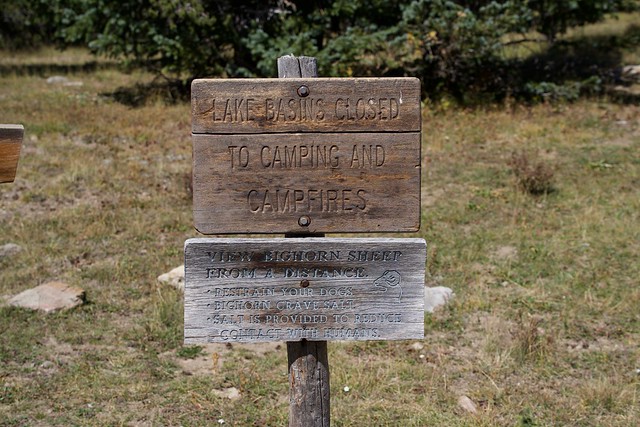
Please don't hound the sheep

Alas, the only bighorn I came across had already had its own, horrible meeting with humans.
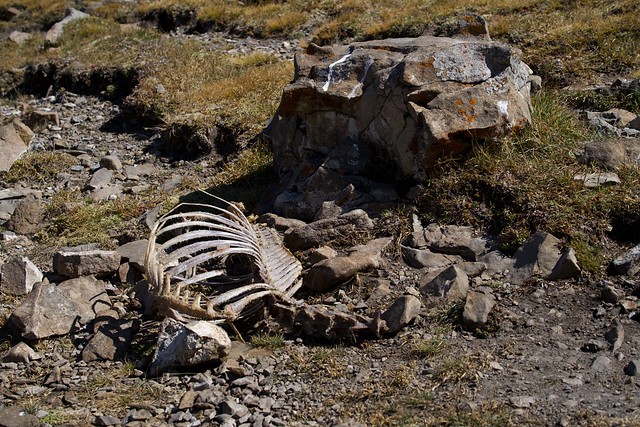
Feast

This year, through a series of lucky accidents, I finally learned about the book "Beatty's Cabin". It's a great, revelatory book. (The web carries several wonderful stories about its author, Elliott Barker, who in his lifetime seems to have regarded the Pecos as his ideal place on earth.)

"Beatty's Cabin" backs up the details of the Taos News article. Like the Nature short film, it explains how bighorn have been harmed both by hunting and by close encounters with domestic sheep.

The Rocky Mountain bighorn sheep, also, were indigenous to this and other areas of the state but their meat was considered the best of all wild meat and, hence, they were sought after like select items on a bargain counter.
In 1873, Coues and Yarrow reported sheep were plentiful in the mountains east of Santa Fe (the upper Pecos) but they were to disappear rapidly after that. Tom Stewart told me many times that the last mountain sheep killed in the area was taken by Jim Bullock at the base of Santa Fe Baldy; near Lake Katherine, in 1902; however, naturalist Vernon Bailey reports in his Mammals of New Mexico that he saw unmistakable tracks of mountain sheep in the Truchas Peaks area in 1903.
It is most probable that rifles were not the sole cause of the depletion of these denizens of the high, timber-line area. When domestic sheep were brought into the high country to graze for brief summer periods, they were often infected with scabies and, perhaps, other communicable diseases or parasites which could easily be transmitted to the bighorns. Domestic sheep could be cured of scabies by forcing them to swim through vats of Black Leaf 40 solution, but Nature provided no such method of treatment for the wild bighorns, and they would be defenseless against the ravages of parasitic infections or diseases new to them, just as the Indians were against smallpox, first brought to them by the white man.

"Beatty's Cabin" ends its story of the bighorn in New Mexico with a statement of hope, one that appears to have been fulfilled.

... with the untimely passing of these spectacular creatures, the jagged crags and templed peaks very definitely lost something of their hereditary charm and glory. On timber-line ridges and in the coves, alpine clover each year sends up its velvety, gray-green leaves and pink-white blossoms in supplication for the return of God’s free wild creatures who once fattened upon its succulence. But none return to eat it. The brows of the high, grassy hills, furrowed and wrinkled by unnatural gullies, frown disapprovingly upon the substitution of herds of domestic woollies for the little bands of wild bighorns that once scanned the glorious landscape from their crests. Restoration is past due.
One effort was made, in 1933, by the State Department of Game and Fish to re-establish bighorns in the Pecos high country. Six animals, two bucks and four ewes, were obtained through the courtesy of the Canadian National Park Service from Banff, Alberta, Canada, and released at the west base of the range. A year later the two rams were seen by Forest Ranger J. W. Johnson at the head of the Pecos on the Santa Barbara Divide, but they have not been heard of since and it must be presumed they met the same fate as their native predecessors. With the material reduction of the number of domestic sheep permitted to summer graze this extremely high vulnerable area and the elimination of the dread scabies from the herds, there is now a good possibility that the Rocky Mountain bighorns might yet be restored to their hereditary range. God speed the day!
Ram

My Heart Belongs to Nature

I'll give the last word to the man who told those great stories on the patio of New Mexico Wildlife Center – and in his own voice, to boot.

2016/10/03

Local Wind Energy Development Has Broad Consequences for Golden Eagles

Local Wind Energy Development Has Broad Consequences for Golden Eagles:

"Together, the stable isotope and genetics data indicate that eagle populations are connected across much of North America and often travel long distances."
This puts me in mind of Grace, a recently deceased golden eagle who had been a resident of New Mexico Wildlife Center. Grace didn't have an easy life; she came to NMWC after being found by a road in northern NM, apparently hit by a car, tail feathers pulled by some heartless scofflaw. While in residence at NMWC she participated in several golden eagle surveys throughout the state, tethered in fields near elk carcass to attract other passing eagles. I don't know when/where the results will be published, but my understanding is that they helped confirm a decline in golden eagle numbers in New Mexico. The reasons for the decline are unknown. Coincidentally, while hiking with friends this last Saturday (1 Oct) near Ironton Park, Colorado, we saw several birds circling above a rock outcropping. Several were ravens. One was a small hawk, either a Cooper's or a sharp-shinned. And one, barely discernible in a photo I snapped, looked very much like a golden eagle.

2014/01/19

Squatting Owls Eavesdrop On Prairie Dogs | LiveScience

The part that caught my eye actually had little to do with the owls:

Squatting Owls Eavesdrop On Prairie Dogs

...prairie dogs have the most sophisticated language yet decoded among non-humans. Recent studies have shown that they have nouns, adjectives, verbs, and adverbs, which they can use to indicate the size, shape, color, and speed of an intruder. The social rodents even have different calls for a tall human in a blue shirt and a short human in a grey shirt.
“In the past, people shied away from the word language, because we didn’t have enough information. But it’s really clear now that’s what it is,” said Con Slobodchikoff, an animal behaviorist at Northern Arizona University in Flagstaff, who studies prairie dog calls.


Growing up, my parents frequently opined that animals of other species were as intelligent, if in sometimes specialized ways, as humans. I bet they'll be pleased by the final paragraph:

“We have for a long time underestimated the ability of animals. We thought they were running on programs of instinct, like little robots,” said Slobodchikoff. “But in reality, they’re far more advanced and far smarter than we give them credit for, and with that acknowledgement we need to give animals more respect than we have been."


As a first step maybe we could stop trying to exterminate prairie dogs...

2013/03/03

Prairie dogs in the NM news

[2013/03/03] Local news briefs - The Santa Fe New Mexican:

"CLOVIS - City commissioners have approved a plan to poison prairie dogs in a Clovis park.

The Portales News-Tribune reported that Clovis city commissioners on Friday approved an emergency budget transfer to purchase 250 containers of Rozol rodenticide to reduce the population of prairie dogs at Ned Houk Park.

The move came after several landowners near the park pressured commissioners about the burrowing rodents.

Resident Glenn Eagle said the prairie dogs have eaten his oat crop in the past, and he's worried they will eat the oats again this spring. He said the rodents are destroying the park by eating the grass and making erosion problems worse.

But Clovis resident Susan Hubby says she was concerned about the long-term effects of Rozol on the park's ecosystem."


I'm starting to collect snippets about prairie dogs. They're interesting creatures, and humans tend to regard them in one of two extreme ways: as dangerous pests to be eradicated, or as cute fur balls to be serenaded by Tibetan monks.

Interesting: Gunnison's prairie dogs, the kind we have here in Santa Fe, have 40 diploid chromosomes, whereas all other species have 50.

Also interesting: prairie dog species can vary quite a bit in appearance and vocalization. Compare this excellent, up-close view of some Denver-based black-tailed prairie dogs, by Yuta Murai, with these clips I took of a small Gunnison's colony here in Santa Fe.

Also interesting, and exemplary of extreme human attitudes toward prairie dogs, is the history of their association with bubonic plague. Some people think they "carry" plague and other deadly diseases such as hanta virus. In fact they suffer from plague, which can quickly wipe out almost 100% of a colony; but they don't carry it from place to place as rats do. And they don't carry hanta virus, or spread it in their droppings.

There's plenty more to write about human attitudes toward prairie dogs (and how we invent myths to justify those attitudes), about their "keystone species" status, etc.


Further Reading / Viewing:

  1. "City approves prairie dog poison", Portales News-Tribune, 1 March 2013
  2. "Tibetan Monks on U.S. Tour Take Moment to Bless Critters", Albuquerque Journal North, 10 August 2008.
  3. Animal Diversity Web
  4. "Prairie dogs", by Yuta Murai
  5. "Prairie Dogs", by yours truly
  6. "Man charged with shooting at prairie dogs", Santa Fe New Mexican, 13 August 2012
  7. "Gunnison's Prairie Dog", Endangered Species of the Mountain-Prairie Region: U.S. Fish and Wildlife Services
  8. "Interspecific Comparisons of Sylvatic Plague in Prairie Dogs", Journal of Mammalogy, Vol. 82, No. 4, November, 2001.
  9. "Recovery and Restoration of the Black-footed Ferret (Mustela nigripes)", American Society of Mammalogists
  10. "Resolution on the Decline of Prairie Dogs and the Grassland Ecosystem in North America", American Society of Mammalogists

2011/01/28

Fibers for fuel

And now for something completely incoherent: a ramble about pikas, horned lizards, ruminants, biofuels and genetic sequencing.

Pikas

I recently posted a video about pikas. Like their fellow lagomorphs, rabbits and hares, pikas can live on indigestible grasses thanks to the bacteria in their caecal pouches. A big part of their body mass is devoted to digestive systems, yet unlike ruminants lagomorphs can't pump their food backward and forward to take advantage of the work done by the gut bacteria. So they have to eat their food more than once.

Horned Lizards

Horned lizards also have proportionally large digestive systems, because they eat ants. And that need for a big digestive system is believed to be one reason horned lizard bodies are so spiky. As DigiMorph explains it:

"Ants are small and contain much indigestible chitin, so large numbers of them must be consumed. Hence an ant specialist must possess a large stomach for its body size to process a lot of material. [...] the stomach occupies a considerably larger fraction of the animal's overall body mass [...] than do stomachs of all other sympatric desert lizard species. Possession of such a large gut necessitates a tank-like body form, reducing speed and decreasing the horned lizard's ability to escape from predators by flight."


The full article is well worth reading. It has a lot more interesting info on horned lizards, including the fact that some of them give live birth. I have read elsewhere that the live-bearing species tend to live at higher altitudes, where it would be difficult to keep eggs sufficiently warm.


Ruminants

Ruminants such as cattle can live on grasses. Their food goes back and forward through several stomach chambers while bacteria break down plant fibers.


Biofuels


Cosmos Magazine reports on genetic sequencing of cow gut bacteria aimed at discovering how to break down cell fibers more efficiently. The techniques of the researchers were somewhat gruesome: they inserted nylon sacks of switchgrass through holes in cows' skin directly into their stomachs. The method was considered necessary because the bacteria of interest could not be cultured.

Once they had enough bacteria they removed the nylon sacks and analyzed the bacterial DNA, looking for genes whose products aid in the breakdown of cellulose.

"It is hoped that this research can speed up the process of breaking down switchgrass into sugars including glucose and xylose to be fermented into ethanol."


2008/10/07

We Are Too Many: 1/4 of World's Mammals Face Extinction

One Quarter of World's Mammals Face Extinction: Scientific American:

" Deforestation, along with hunting or gathering food are the prime causes of the rapid declines in land mammals, such as elephants in Asia; most endangered marine mammals, like the vaquita in Mexico's Gulf of California, are killed by fishing nets, ship strikes or pollution."
"Vast tracts of tropical rainforest have been replaced by palm oil plantations for food and biofuels, satellite imagery reveals."

2008/07/24

Many little parasites add up to one big biomass - earth - 24 July 2008 - New Scientist Environment

The main point of the article is that parasites are much more populous than previously believed. But this quote was the most interesting:

Many little parasites add up to one big biomass - earth - 24 July 2008 - New Scientist Environment:

"Dobson says he has work in press showing that parasites contain between 10 and 1000 times more pollutants than their hosts. He suggests parasites might play an important role in cleaning up the animals they inhabit."


So they castrate you, but they also keep you clean...