2019/10/24

Giuliani’s Ukraine Team: In Search of Influence, Dirt and Money - The New York Times

Two weeks later, this is still unsettling. Giuliani’s Ukraine Team: In Search of Influence, Dirt and Money - The New York Times:

Over the past year, the two men connected Mr. Giuliani with Ukrainians who were willing to participate in efforts to push a largely unsubstantiated narrative about the Bidens.
The headline says "Dirt" - which sounds like "something unsavory but true". But that's not what these devils were after. They looked for people who were willing to say bad things about the Bidens, even if those bad things were lies.

2019/10/21

The Death of Stalin

Inside Trump's First Pentagon Briefing - POLITICO Magazine:

Things quickly got interesting as senior leaders jockeyed for influence.
[Bolton's] comment seemed to indicate that as national security advisor he should be the integrator and therefore the de facto lead.
Mnuchin tried to wield the most influence by making sweeping, declarative statements as if he was speaking for the White House. Kudlow was also attempting to assert himself...
It was as if the treasury secretary and chief economic adviser had started their own trade war in the Pentagon.
Gathering his things, [Mattis] turned and walked out of the room and down the hall, fully expecting the others to flow out of the room behind him.
They didn’t.

2019/10/19

BEV, ICE and Cobalt: an illuminating Twitter thread

Thanks to Robert Llewellyn for resuscitating the following Twitter thread. Unfortunately, the thread is so old that neither Thread Reader App nor Twitterrific is able to retrieve it. Twitter's web interface can still retrieve it, so I've taken the liberty of transcribing it below.

Synchronicity on Twitter: "The Dirty Secrets of #ICE - Part 1..." / Twitter:

The Dirty Secrets of #ICE - Part 1 Whenever there’s a debate about the benefits of battery electric vehicles #BEV vs internal combustion engine #ICE vehicles, one of the 1st things usually mentioned is cobalt with lurid stories such as linked here.
But when you fill your tank with petrol or diesel did you know that cobalt is used as a key ingredient?
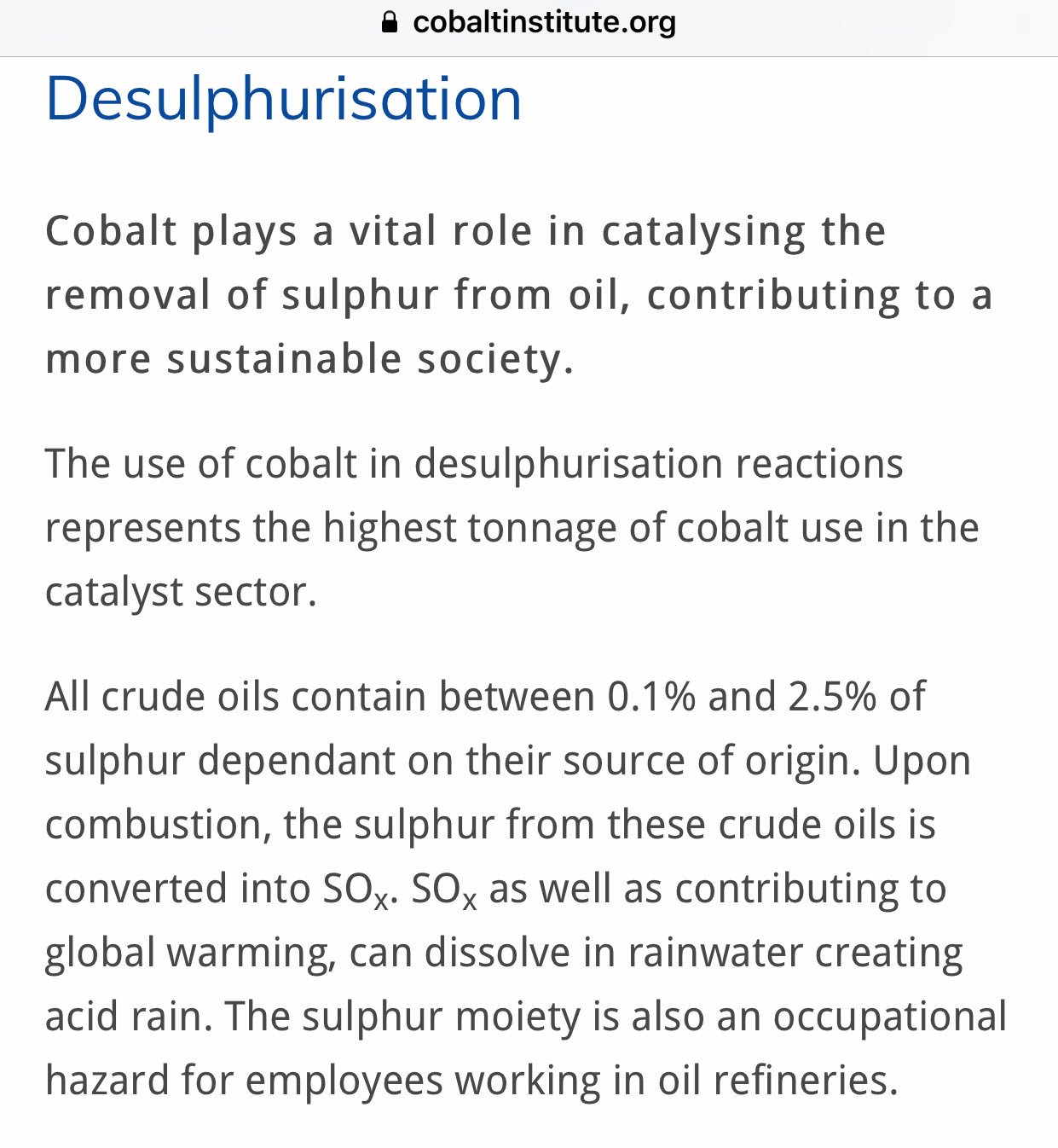
When we figured out that sulphur in our fossil fuels was a key component to acid rain (remember acid rain?) & also contributed to serious health issues it was decided that ultra low sulphur fuels was the way to go. But the catch is that removing sulphur during the refining process is actually quite hard. You need something to act as a catalyst to aid the Desulphurisation process. So they added a metal to kick start the key reaction.
And yes, the metal they add is cobalt. Here’s the lowdown from the “Cobalt Institute” (cont) https://cobaltinstitute.org/desulphurisation.html
It’s a long and detailed article but the key information is in the first few paragraphs.
So to make low sulphur petrol & diesel, which is the global standard now, they must add cobalt during the refining process. Yes, but that cobalt doesn’t get into the final product we put into our tanks right? Right?? Wrong!!! In fact a lot is left in the final output.
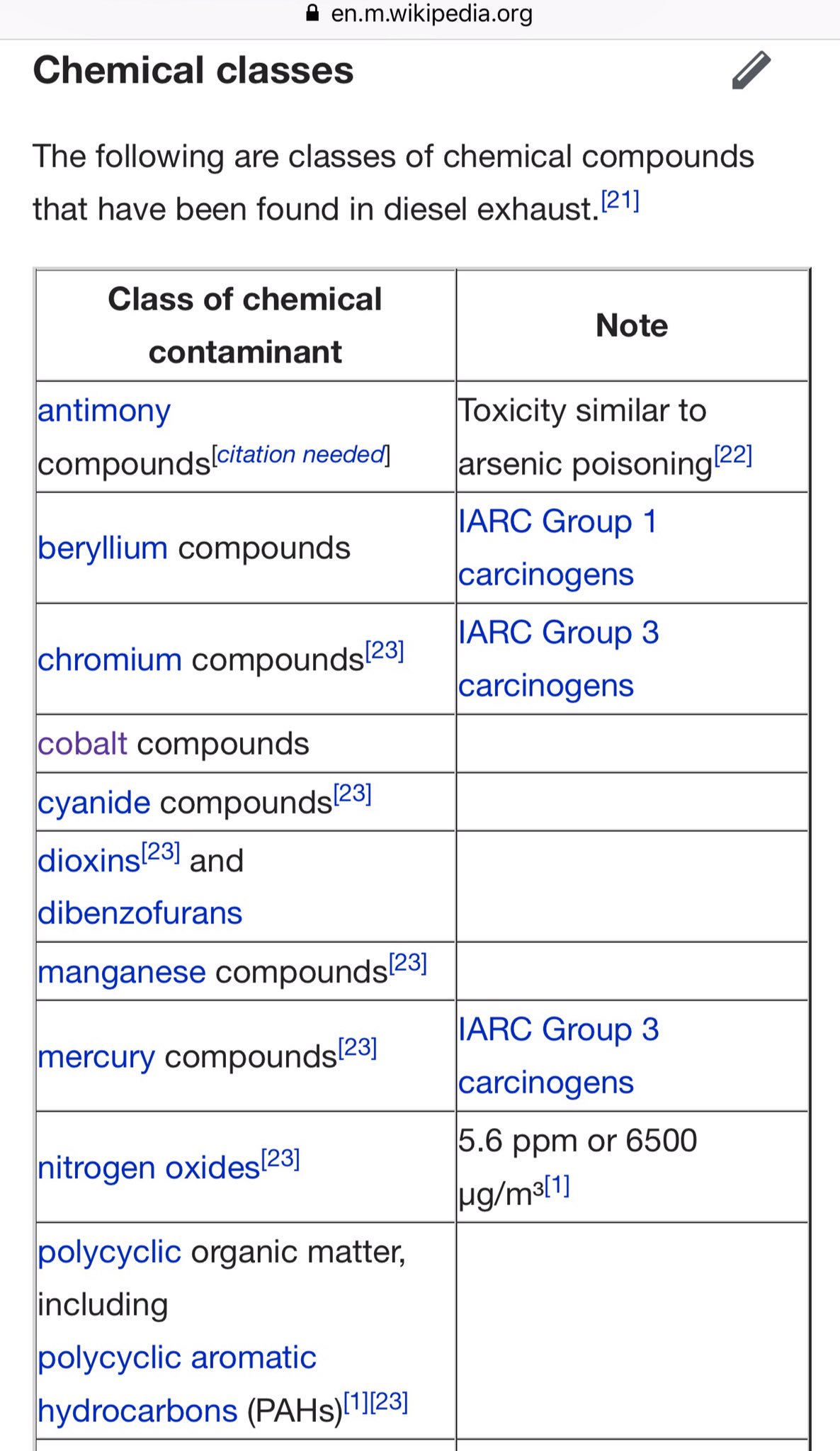
Check out the list of toxins and carcinogens that make up ordinary everyday diesel exhaust emissions for instance. Yes it’s a long list of nasties but look who’s there? Yes, it’s our friend cobalt.
So when the anti-BEV lobby start shouting about cobalt in batteries, tell them about the cobalt in their fuel. At least the cobalt in the battery *stays* in the battery and can be completely recycled. The cobalt in their fuel is spewed out the exhaust for our children to breathe.
And then we should consider how Cobalt relates to EV batteries. So this from Amnesty International confirms that about 20%, at most, of the cobalt from the DRC is hand mined. The rest is machine mined.
Overall, about 60% of the world’s supply comes from the DRC. So that means only about 12%, at the very most, of the global supply of cobalt is actually hand mined. Also add that a lot of that cobalt is used for other things like high quality steel, and the fact that a lot is also used in cell phone, tablet, laptop batteries, and petrol/diesel fuel of course, and that the amount of cobalt actually in EV batteries has fallen dramatically. The chances of hand mined cobalt getting into your EV battery is next to nil.
So it’s just disingenuous & misleading to link unethically sourced cobalt solely with EVs when in reality it’s used for a lot more other applications in every part of our society. But of course it serves many parties with anti-EV interests for that false association to be made.
Some selected replies:

simon blackmore @blackmore_s Jun 20

#FFS the #FUD they peddled about BEV's battery chemistry and they are pumping that crap into the air via exhaust fumes.

DIYMicha @DIYMicha Jun 22

... and cobalt is an ingredient in hardened high temperature steel, used in valves and valve seats of ICE engines.

Synchronicity @Synchronicity34 Jun 22

Yes indeed, mentioned further down in the thread.

Synchronicity @Synchronicity34 Jun 21

But the cobalt in batteries stays in the batteries and is then recycled. The cobalt in fuel is distributed though our most populous cities, day upon day, accumulating on our streets, in the air, in our children’s lungs. Which source should you be most immediately worried about?

Synchronicity @Synchronicity34 Jun 21

Key research on the long term cumulative effects of our children ingesting heavy metal particulates such as cobalt are only just starting. I don’t think you are qualified to say whether any other issue is bigger.

Follow the Testimony

Susan B. Glasser, in The New Yorker:

Kent, Sondland, and Yovanovitch remain U.S. government officials, and could be fired. Both Kent and Yovanovitch ... have given decades of service to their country at the State Department. This is bravery of a sort that has become so rare in our public life as to be almost unimaginable.
Trump himself, in other words, was putting together a rogue foreign-policy team, run by Giuliani, the President’s private attorney, that would go outside normal N.S.C. and State Department channels to pressure Ukraine.
The ... outlines ... have been known since the start ... but the testimony by Hill and others ... shows how much the President was directly implicated... The scandal, as this week showed, is about a lot more than saying “do us a favor though” in a phone call.
Hill’s decision to appear on Monday, in defiance of White House demands, was crucial.
... there is nothing the White House can do to retract the sworn statements of its officials who are now coƶperating with the impeachment probe on Capitol Hill.
Trump has been staffing his cabinet with "temporary" and "acting" officials who haven't been vetted by Congress. He has been hollowing out federal agencies and replacing career bureaucrats with people loyal to himself, rather than to our Constitution. These changes have made it easier to violate the law in secret (Giuliani and Mulvaney notwithstanding). Other changes, like the near elimination of press briefings, have made it harder to ask even informal questions about the actions of Team Trump. Its refusal to cooperate with Congressional inquiries has been a brazen attempt to avoid all accountability. Sarah Kendzior seems to have understood this administration from the start.
I studied dictatorships and authoritarian regimes the entire time I was doing my PhD.... A lot of things that Trump was doing in his campaign reminded me of things I saw in Uzbekistan, Russia, and other authoritarian states around the world.
Thank goodness the House of Representatives began to fulfill its duty re impeachment before the executive was completely gutted. Thank goodness Trump and his toadies are so inept. Where might we be now if they were actually skilled? Added bonus: Vanity Fair

A World We Built to Burn - Quinn Norton

A World We Built to Burn | emptywheel:

So here we are: Keeping the lines on will probably kill people. Turning them off will probably kill people. Our political system is facing a real-life trolley problem created by our ever-expanding technical debt. It can’t have been easy for the people making the decisions.
One of our jobs in this century is to accept that we don’t live on the planet we thought we lived on, and our societies aren’t doing what we thought they were. Even if we were able to change our politics overnight, which is probably impossible without some planetary level disaster wake up call, it would still take many decades to dig ourselves out of out technical debt, and in the mean time, we have to stay alive and try to thrive.
I can imagine you looking at the screen, saying “It shouldn’t be this way!” But it is this way. The world we thought we had, with a safe stable environment and not too many people, that is not the world we live in. That is, in short, not real. At the individual level as well as the policy level, we need to let go of that which is not real.
Framing a mesh of interrelated social, political and environmental problems as technical debt is brilliant. Finding it on emptywheel, a site that I visit for its insights into the takeover of our federal government, is surprising but welcome.

2019/09/28

White House restricted access to Trump's calls with Putin and Saudi crown prince - CNNPolitics

White House restricted access to Trump's calls with Putin and Saudi crown prince - CNNPolitics:

Administration officials say John Eisenberg, the White House deputy counsel for national security affairs and a national security legal adviser, directed the Ukraine transcript call be moved to the separate highly classified system, as detailed in the whistleblower complaint. That system is normally reserved for "code word" documents that are extremely sensitive, such as covert operations.
The White House acknowledged earlier Friday that administration officials directed the Ukraine call transcript be filed in a highly classified system, confirming allegations contained in the whistleblower complaint.

2019/09/26

The Risk Trump Poses to All Americans | emptywheel

The Definition of "Collusion" as Impeachment Proceeds: the Risk Trump Poses to All Americans | emptywheel:

So not only do Americans lose out on having a President who makes decisions based on how they benefit the country rather than himself personally, but they also get a far weaker President in the bargain, someone who — if he ever decided to prioritize American interests over his own — would have already traded away his bargaining chips to do so.
Please read the whole post.

Manafort, Giuliana, Trump and Ukraine

Thread by @AshaRangappa_: "Manafort was calling the shots to WH[?]":

This is the part that was most interesting to me: The part where Fruity and Trump feel they need to “reassure” Manafort that he’ll get a pardon, like they have to keep him happy. Why? šŸ¤”
What a tangled web...

2019/09/23

How to Break Trump's Stonewall - The Atlantic

How to Break Trump's Stonewall - The Atlantic:

Pressed for his reaction, Ervin said Nixon’s position was “executive poppycock, akin to the divine right of kings.” Ervin declared that his committee had no intention of submitting to the suggested judicial delays, but would instead utilize the Senate’s sergeant at arms to arrest any recalcitrant White House aide, bring him to the bar of the Senate for trial, and ultimately compel him to testify.

2019/09/21

Impeach Already

If Trump extorted a foreign leader for political gain, it’s impeachment time - The Washington Post:

This complaint was considered so troubling by a Trump-appointed inspector general that he asked that the acting director of national intelligence, Joseph Maguire, immediately forward the complaint to Congress, but Maguire refused to do so, reportedly on the advice of William Barr’s Justice Department.
Everything You Need to Know About the DNI, the IG, and the Whistleblower Report - The Bulwark:
Upon receipt of the report from the IG, the DNI “shall within 7 calendar days of such receipt, forward such transmittal to the congressional intelligence committees” of Congress. “Shall” means shall. It does not mean “may” or “if the DNI agrees with the inspector general.”
George Conway and Neal K. Katyal: Trump has done plenty to warrant impeachment. But the Ukraine allegations are over the top. - The Washington Post:
So it appears that the president might have used his official powers — in particular, perhaps the threat of withholding a quarter-billion dollars in military aid — to leverage a foreign government into helping him defeat a potential political opponent in the United States.
If Trump did that, it would be the ultimate impeachable act. Trump has already done more than enough to warrant impeachment and removal with his relentless attempts, on multiple fronts, to sabotage the counterintelligence and criminal investigation by then-special counsel Robert S. Mueller III and to conceal evidence of those attempts. The president’s efforts were impeachable because, in committing those obstructive acts, he put his personal interests above the nation’s: He tried to stop an investigation into whether a hostile foreign power, Russia, tried to interfere with our democracy — simply because he seemed to find it personally embarrassing. Trump breached his duty of faithful execution to the nation not only because he likely broke the law but also because, through his disregard for the law, he put his self-interest first.
Trump whistleblower complaint involving Ukraine, explained - The Washington Post:
The overlapping timelines of Coats’s resignation, Maguire’s elevation and the whistleblower complaint are also raising eyebrows. Trump announced the exit of Coats, with whom he occasionally clashed, on July 28. That’s three days after his call with Zelensky. Trump announced Maguire’s selection Aug. 8. Four days later, the whistleblower complaint was filed.
Trump Whistleblower Complaint: The Obvious Problem with Rudy Giuliani's Spin on Ukraine | National Review:
There is not a Republican alive who would find it acceptable for a Democratic president to press a foreign country to work with his personal lawyer to investigate a domestic political rival.

2019/06/26

Give us your tired...

Thread by @Breznican:

When I got back to the office, a senior reporter said, “So you went out with Nick? How’d it go?”
“Great,” I said, not wanting to call it “boring.” “We got some good stuff.”
“What’d you think of Nick?”
I wasn’t sure how to answer this. There was expectation in the question.
Was there something wrong with Nick that I didn’t realize?
“He was cool,” I said. “Nice guy.”
The older reporter just stared at me. Reading me. “You know who he is, right?”

2019/06/06

Leadership and Sacrifice - Against Demagoguery

My father served on D-Day. He experienced a leader who spawned hatred. - The Washington Post:

He walked by himself among the gravestones of his compatriots from the 4th Infantry Division, and eventually stopped and stood for a long time at the marker of one of his commanders, Brig. Gen. Theodore Roosevelt Jr.
Later we asked my dad why he spent the most time at Roosevelt’s grave, rather than at the resting places of his fellow infantrymen... he showed us where he had landed on Utah Beach and described seeing the general standing calmly amid the indescribable chaos of battle and firmly directing the troops ashore. He said Roosevelt’s selfless, honorable leadership heartened him and, he presumed, thousands of other terrified young soldiers on that day.
They all were war heroes — the captured, the killed, the wounded, the mentally maimed, the lucky survivors such as my dad — because of circumstance, not desire. They went to war because of what happened when xenophobia and demagoguery supplanted real leadership.

2019/05/04

Juxtapose

Five Things I Learned From the Mueller Report

The president committed crimes.
The president also committed impeachable offenses.
Sara Kendzior: Impeachment Isn't Optional for Democrats
Sarah Kendzior laid out the case for the impeachment of Trump this morning on AMJoy, as she usually does, that it's not an optional situation for the Democrats. In her opinion, they have no choice in the matter, that the body of evidence is so clear, so obvious by now that that is the only true course of action. It's their Constitutional obligation, their actual job to have impeachment hearings on Trump.
Pelosi Warns Democrats: Stay in the Center or Trump May Contest Election Results
Speaker Nancy Pelosi does not believe President Trump can be removed through impeachment — the only way to do it, she said this week, is to defeat him in 2020 by a margin so “big” he cannot challenge the legitimacy of a Democratic victory.

(I hope she's right. This is a terrible gamble to take.)

That is something she worries about.
“We have to inoculate against that, we have to be prepared for that,” Ms. Pelosi said during an interview at the Capitol on Wednesday as she discussed her concern that Mr. Trump would not give up power voluntarily if he lost re-election by a slim margin next year.
Donald Trump Won't Say if He'll Accept Result of Election [2016]
Mr. Trump insisted, without offering evidence, that the general election has been rigged against him, and he twice refused to say that he would accept its result.
“I will look at it at the time,” Mr. Trump said. “I will keep you in suspense.”

For me this statement by itself should have disqualified Mr. Trump from the office of U.S. President. In effect he was saying he would not respect the laws which he would be required to swear to uphold.

“That’s horrifying,” Mrs. Clinton replied. “Let’s be clear about what he is saying and what that means. He is denigrating — he is talking down our democracy. And I am appalled that someone who is the nominee of one of our two major parties would take that position.”

Climate change: Bill McKibben’s advice for activists - Vox

Climate change: Bill McKibben’s advice for activists - Vox:

Sean Illing
I worry a lot of people have trouble connecting the dots between these food supply disruptions and the political chaos that results from them. For instance, you point out how a 2010 heat wave in Russia, which wrecked their grain harvest, led directly to the Arab Spring. How did that happen and what are similar scenarios that could play out in the near future?
Bill McKibben
That happened because the Arab world is the biggest importer of grain from eastern Europe and when the price went way up for a loaf of bread, the predictable trouble ensued. Probably an even more dire example is what happened in Syria. In the early part of this century, we had the deepest drought ever recorded in the Fertile Crescent. That drove an immense number of Syrian farmers, maybe a million farm families, off their land and into the cities.
And there’s been a lot of academic work to establish that that was one of the key things that triggered the civil war (here and here). Syria was already a brutal and unstable place, unable to cope with this massive influx of people. And so many of those people were spun out into the rest of the world where they utterly discombobulated the politics of Western Europe inside of 18 months.
So we can look at what happened in Syria and Europe and expect much more of that in the century ahead. And I think the low end is 200 million climate refugees and the high end approaches a billion. So take the kind of upheaval that the wave of refugees out of Syria created and multiply it by a couple of hundred and ask yourself how that’s going to impact war and peace, or development, or any of the other things we desperately care about?

2019/04/18

New Mexico seeks energy savings in state building upgrades | Local News | santafenewmexican.com

New Mexico seeks energy savings in state building upgrades | Local News | santafenewmexican.com:

New Mexico is pushing forward with multimillion-dollar, energy-saving upgrades to its portfolio of agency buildings in the state capital, as part of an emerging climate-change strategy from Democratic Gov. Michelle Lujan Grisham.
The General Services Department which oversees more than 800 buildings plans to invest $32 million on projects to improve the energy efficiency of state buildings in Santa Fe and generate on-site renewable electricity with photovoltaic solar panels.
The state government’s first battery storage for solar energy is part of the project.
State legislation approved this year provides $20 million in direct spending on the energy upgrades at state buildings.
The contractor hired to implement building improvements in Santa Fe has guaranteed energy-related savings of $1.1 million a year... The state expects actual annual savings of about $1.4 million.
Separately, General Services said it has received $1 million in state funds to purchase electric vehicles for use by state workers. Another $1.5 million is going toward the creation of vehicle charging stations at state facilities within Santa Fe County.
It's very encouraging to see all of this. Thank you, Governor Lujan Grisham.

2019/04/02

North Carolina Orders Duke Energy to Excavate All Coal Ash - The New York Times

Michael Shellenberger has observed that, of all current types of electricity generation, only nuclear has the cost of waste management included in its price. Now some of that cost is being rolled, almost retroactively, into the cost of electricity from coal. North Carolina Orders Duke Energy to Excavate All Coal Ash - The New York Times.

2019/04/01

Is Nuclear Power the Key to Finally Reducing the CO2 Footprint?

NB: These are essentially the same points Michael Shellenberger makes, but they come from a different source. Is Nuclear Power the Key to Finally Reducing the CO2 Footprint?:

In about 20 years, at a cost of at least two hundred billion dollars, it has added about 80 gigawatts of wind and solar generating capacity—enough in principle to cover its winter peak—to its energy mix, an amazing feat in itself.
the International Energy Agency shows that the amount of CO2 generated per kWh of electricity in Germany is still about 480 grams, despite their large investment in wind and solar technology. The reason is that the country still relies on coal and natural gas for about half of its electricity, as its wind and solar fleet lay idle most of the time. In the meantime, France—which relies on nuclear power for 75 percent of its electricity—generated only about 70 grams of CO2 per kWh. When France decided to go nuclear after the first oil shock in 1973, it derived about two thirds of its power from coal and oil-fired power plants and emitted 500 grams of CO2 per kWh. Twenty five years later, its power sector was almost carbon-free.
Because of its reliance on nuclear power, France currently has one of the lowest rates of CO2 emissions per kWh in Europe. Every year, the French power sector emits approximately 260 million fewer tonne (metric ton) of CO2 than its German counterpart, despite similar productions (respectively 560 billion kWh and 630 billion kWh). This is equivalent to taking 175 million cars off the road (assuming an average emission of 0.15 kg-CO2 per car and per km and 10,000 km per car and per year)—about 75 percent of the whole European fleet of personal vehicles.
Delays in implementation caused by legal and regulatory issues—in particular those associated with long-term liability—are likely when it comes to choosing the sites that will have to permanently host billions of tonnes of CO2. Such delays have been happening for the geological disposal of used nuclear fuel. However, unlike used nuclear fuel, which can be safely stored at reactor sites while waiting for a final disposal solution, CO2 is currently released to the atmosphere until a final solution emerges—which could take a while.
After more than two decades spent analyzing available data, experts from institutions such as the World Health Organization and the United Nations Environment Program, concluded that 43 people died of causes directly attributable to the Chernobyl accident. They also indicate a potential 3 percent increase in cancer mortality in the 600,000 most exposed people. In such a large population, unfortunately, more than 120,000 lethal cancers are expected to occur spontaneously—independently of any radiation exposure—and the Chernobyl accident may add 4,000 cases to this macabre toll. However, a long standing issue associated with this predicted increase is that it cannot be verified with certainty because it is much smaller than—and mostly undistinguishable from—the background of spontaneous cancers.
Finally, whereas most of the general public will very likely point at the Chernobyl and Fukushima accidents as the worst modern science and engineering failures, only very few will remember the 1975 collapse of the Banqiao dam (China) where approximately 26,000 people died from flooding and another 145,000 died because of epidemics and famine. Another dam, Machchu-2, in India also failed a few years later (1979) killing at least 2,000 people. Experience shows that nuclear power does not entail more risk than other industries.
Assuming a typical consumption of 7,000 kWh per year, a person living in San Francisco would be responsible for the production of about 6.2 cubic centimeters of used nuclear fuel per year weighing 18 grams if the electricity came only from a nuclear power plant. It would take about 55 years for this person to fill the equivalent of a can of soda with used nuclear fuel. So, yes, these used fuel assemblies contain very dangerous materials—standing next to one, unprotected, would kill you in a few minutes—but there is very little of it. If the same electricity had come only from a gas—natural or bio—power plant during the same 55 years, that person would have been responsible for the emission of about 190 tonnes of CO2—900,000 cans of soda or one every half-hour—and twice that amount if it had come from a coal power plant.

In New Mexico, renewables don't always mean clean energy | Local News | santafenewmexican.com

2008 brought plans to erect wind turbines across the Taos plateau. Last year long-distance transmission lines were ready to carry wind power across the bird migration routes near the Bosque del Apache. And now this: a geothermal plant may be harming an aquifer in New Mexico's Animas Valley. This is an interesting read from the Santa Fe New Mexican, about roses, tilapia, politics and energy politics: In New Mexico, renewables don't always mean clean energy | Local News | santafenewmexican.com:

Riding his horse through cattle pasture of brush and brittle mesquite, Randy Walter spotted a 10-foot geyser spewing from a well that had been capped and padlocked for 12 years.
The dark side of renewable energy is that every form of production carries its own environmental baggage.
During the 2012 legislative session, Southern New Mexico Democrats Sen. John Arthur Smith and Rep. Rudy Martinez co-sponsored a bill that took jurisdiction over 250-plus-degree water from the Office of the State Engineer and placed it in the hands of the Oil Conservation Division.
In other words, the hot water was no longer considered water, but energy. The agency historically tasked with managing water in New Mexico was stripped of its authority over the project.
One of the people unafraid to speak out is Meira Gault, a 69-year-old cattle rancher who once served in intelligence in the Israeli Army and has been a Hidalgo conservation district official for 11 years.
Gault said she views the well blowout as the surest sign that the geothermal water simply isn’t going where Cyrq promised it would go.